Sapphic Sleuths in Sandals: Why We Love This Series
Representation matters — even in ancient Thebes. N.L. Holmes’s series of standalone historical mysteries introduces us to Neferet and Bener-ib, two women in love and determined to bring healing and justice to their corner of the world. Alongside a whip-smart teenage apprentice and a devoted father figure, they take on a string of chilling murders that cut through class, commerce, and community.
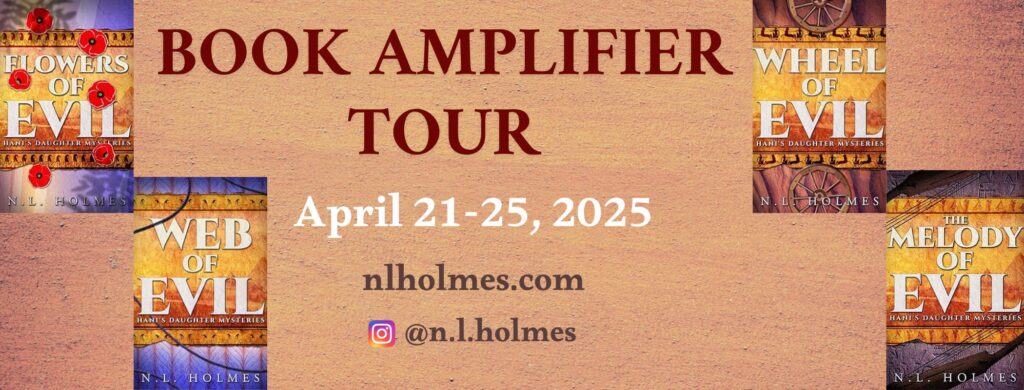
Each book — Flowers of Evil, Web of Evil, Wheel of Evil, and The Melody of Evil — immerses you in a new mystery, but the same thoughtful character dynamics and gorgeous worldbuilding carry through all four.


Flowers of Evil (Hani’s Daughter Mysteries Book 1)
Web of Evil (Hani’s Daughter Mysteries Book 2)
Wheel of Evil (Hani’s Daughter Mysteries Book 3)
The Melody of Evil (Hani’s Daughter Mysteries Book 4)
Author Interview
How did you do research for your book?
I had a lot of general background from teaching a class on Ancient Egypt, but I hit my library again for specific knowledge about various professions, etc. I find names from ancient manuscripts about village life or lists of tomb owners.
Which was the hardest character to write? The easiest?
In this series, I’d say Neferet was the easiest to write. She first appears at the age of seven in the first Lord Hani Mystery, so her character is pretty well set by the time she’s grown and gets a series of her own. Bener-ib was probably the hardest. She’s a timid, retiring person, who is very different from myself (unlike Neferet!).
In your book you make a reference to ancient Egyptian medicine. How did you come up with this idea? What made you write a book about medicine?
The Egyptians’ medical skills were world-renowned in their day. They had observed by trial and error over millennia and written down the results of their experiments, so that a young doctor like Neferet could look in a casebook and see what her elders had done to treat those symptoms. A lot of it was herbal, much like traditional medicine today. This was always one of the most popular lectures when I taught my Ancient Egypt class, and it gave me a certain forensic capability for my sleuths.
Where do you get inspiration for your stories?
I began the Lord Hani Mysteries, from which this series is spun off, when I met the real Hani in a set of ancient documents called the Amarna Letters. There were references to a lot of diplomatic missions carried out by this man, so I took him as my protagonist and gave him a personality and a family. When Hani’s arc was completed, I zeroed in on his youngest daughter, a headstrong, unconventional girl who seemed likely to follow in her father’s footsteps.
There are many books out there about ancient Egypt. What makes yours different?
There are even a lot of mysteries set in Egypt, but this series has a female protagonist who is a physician, so she’s automatically privy to a lot of mayhem. Her father is a diplomat, and that draws into her orbit various foreigners as well. Plus, for those who like cozy mysteries, this is one, with the addition of Egyptian “tea time” vibes and heroic pet animals.
What advice would you give budding writers?
Use a professional editor, even if you are one yourself. Nobody can judge their own work. And if you’re new to writing (or not), you’ll learn ever so much from the trained critique of these people. It’s better than a course in creative writing.
Do you have another profession besides writing?
I’m an archaeologist. I’ve also been an antiques dealer, a cloistered nun, an interior decorator, and an administrative assistant. Believe it or not, all of these activities have contributed something to my writing.
How long have you been writing?
I’ve been writing fiction for eleven or twelve years. Before that, it was just poetry and, of course, academic articles. Poetry really adds to one’s fiction chops, but I’m afraid academic writing has to be unlearned – it’s all about not having a distinctive voice. It does help in terms of using the language skillfully and knowing grammar.
Do you ever get writer’s block? What helps you overcome it?
I haven’t had a serious case of block since my very first book. I was trying to make outlines and plan out the story in advance, as the books tell you to do, and I thought I’d die! I couldn’t think of a thing! When I finally just started writing and let the characters shape the story, it went well. Now, if I ever stall out, I jump around and write separate scenes that interest me, then incorporate them later – but I keep pushing forward, even if not sequentially.
What is your next project?
I’m working on another Neferet mystery that features the world of cooks (each of these books deals with a different profession). I also have in mind a prequel to the Lord Hani Mysteries, because there’s one more real historical adventure of Hani to make use of.
In today’s tech savvy world, most writers use a computer or laptop. Have you ever written parts of your book on paper?
Sometimes I’ve written on a train or in a waiting room, hence on a legal pad. But it’s so hard to read my own draft, with its scratch-outs and arrows, that it’s almost better to wait until I have a keyboard in front of me, despite the fact that I’m a terrible typist.
What’s the funniest thing that ever happened to you? The scariest? The strangest?
When I was young, I used to do Spanish dancing – sort of semi-professional. Once my heavy petticoat fell off on stage! I had to step out of it and keep going. Scary? Another petticoat thing. We lived in a kind of rustic area, and one day there was clearly a skunk around. That night, when I was heading out to the car with my costume over my arm, I heard a rustling behind me. Every time I stopped, the sound would stop, but as soon as I began to walk, it followed me. I was sure it was the skunk! Turned out it was my petticoat dragging the ground.
What’s the most courageous thing you’ve ever done?
I quit my job because the director had done something gangsterish and dishonorable to a volunteer.
Any hobbies? or Name a quirky thing you like to do.
Too many hobbies! I play the violin (badly), weave/spin, paint, dance, garden, keep bees, hike, write poetry. I used to drive a jog cart, and I’m currently trying to learn to knit. A lot of these things started as research for books.


Note: Some posts may contain affiliate links. Should you choose to purchase a product, we will receive a small commission for the sale at no additional cost to you. Chapter Break is a participant in the Amazon Services LLC Associates Program, an affiliate advertising program designed to provide a means for sites to earn advertising fees by advertising and linking to Amazon.com.