
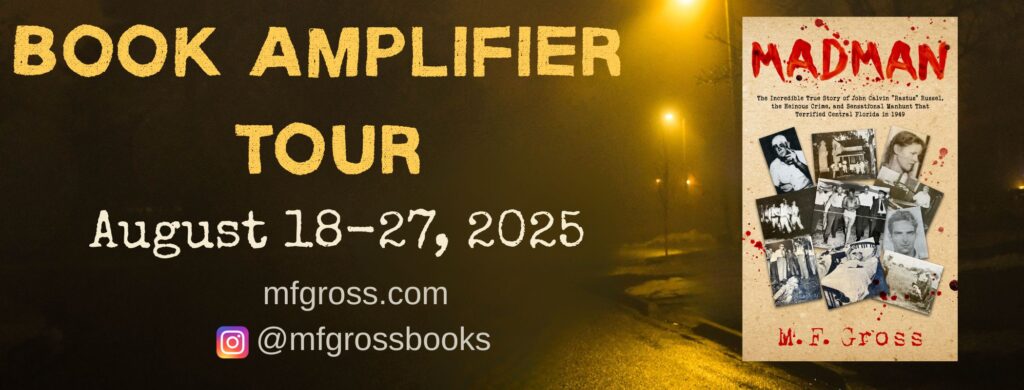
True crime often tells us who did it. But the best stories tell us what it meant. Madman by M.F. Gross is one of those rare books that balances suspense with historical and emotional depth, turning a forgotten manhunt into a full-bodied exploration of fear, justice, and memory.
Madman
by
In 1949, Crystal Beach, Florida was devastated by a gruesome murder that set off one of the longest and most frantic manhunts in state history. The suspect—John Calvin “Rastus” Russell—was a violent, unpredictable ex-convict and former psychiatric patient whose escape from a mental institution just weeks earlier had gone largely unnoticed. When a young mother turned up dead, local law enforcement—and the community at large—were forced into action. Madman meticulously reconstructs the month-long manhunt that followed, placing readers in the thick of it: in the groves, the swamps, the patrol cars, and the minds of the townspeople who lived in fear. But it also asks deeper questions: What does a town do with that kind of trauma? Who gets remembered—and who gets forgotten?
Amazon: bit.ly/47jCHui
Goodreads: https://www.goodreads.com/book/show/235731573-madman
Author Interview
How did you research your book?
I started with pulling all newspaper and media files from the entire incident. From there, I incorporated private researchers, a private detective (to locate survivors and descendants of those involved – for interview purposes), visits to actual locations, police files, files from local historical societies, ancestry.com, etc, etc, etc…. It was a time consuming but fascinating process.
What’s the hardest scene or character you wrote—and why?
The hardest scene to write was the actual murder scene and what happened right before it. The only witness was Mrs. Browne and she was not only hit on the head and likely suffering from concussion, she may have had something to hide. Some of her explanations and time lines simply do not make sense. I had to connect the dots on some of it.
Where do you get your ideas?
I never planned or aspired to be a true crime writer. I just discovered that this story happened in my own neighborhood, just 100 yards from my house, 75 years ago. I became fascinated with it and decided to write the book. It’s funny how second careers start!
What sets your book apart from others in your genre?
For one, it is a period piece. It happened in 1949 so part of it is recreating the time period. Secondly, it’s not a straightforward true crime piece. It starts out as “Charles Manson comes to 1949 Mayberry.” But then it morphs into an action/adventure, cat and mouse like chase movie, all wrapped within a twisted love story involving a teenaged girl. Oh yeah, and the judge that set the killer free years earlier? He might have been his father.
How did you research your book?
I started with pulling all newspaper and media files from the entire incident. From there, I incorporated private researchers, a private detective (to locate survivors and descendants of those involved – for interview purposes), visits to actual locations, police files, files from local historical societies, ancestry.com, etc, etc, etc…. It was a time consuming but fascinating process.
What’s the hardest scene or character you wrote—and why?
The hardest scene to write was the actual murder scene and what happened right before it. The only witness was Mrs. Browne and she was not only hit on the head and likely suffering from concussion, she may have had something to hide. Some of her explanations and time lines simply do not make sense. I had to connect the dots on some of it.
Where do you get your ideas?
I never planned or aspired to be a true crime writer. I just discovered that this story happened in my own neighborhood, just 100 yards from my house, 75 years ago. I became fascinated with it and decided to write the book. It’s funny how second careers start!
How did you research your book?
I started with pulling all newspaper and media files from the entire incident. From there, I incorporated private researchers, a private detective (to locate survivors and descendants of those involved – for interview purposes), visits to actual locations, police files, files from local historical societies, ancestry.com, etc, etc, etc…. It was a time consuming but fascinating process.
What’s the hardest scene or character you wrote—and why?
The hardest scene to write was the actual murder scene and what happened right before it. The only witness was Mrs. Browne and she was not only hit on the head and likely suffering from concussion, she may have had something to hide. Some of her explanations and time lines simply do not make sense. I had to connect the dots on some of it.
Where do you get your ideas?
I never planned or aspired to be a true crime writer. I just discovered that this story happened in my own neighborhood, just 100 yards from my house, 75 years ago. I became fascinated with it and decided to write the book. It’s funny how second careers start!
What sets your book apart from others in your genre?
For one, it is a period piece. It happened in 1949 so part of it is recreating the time period. Secondly, it’s not a straightforward true crime piece. It starts out as “Charles Manson comes to 1949 Mayberry.” But then it morphs into an action/adventure, cat and mouse like chase movie, all wrapped within a twisted love story involving a teenaged girl. Oh yeah, and the judge that set the killer free years earlier? He might have been his father.
Any quirky writing rituals or must-have snacks?
Not really. Well, yes, I guess I would typically have an ice coffee before I started. Milk, no sugar. I’d put enough milk in so it looked like a White Russian in a glass.
Any quirky writing rituals or must-have snacks?
Not really. Well, yes, I guess I would typically have an ice coffee before I started. Milk, no sugar. I’d put enough milk in so it looked like a White Russian in a glass.
About the Author
M.F. Gross is a Florida-based narrative nonfiction writer with a passion for forgotten history and the communities shaped by it. A former financial writer, he transitioned into investigative storytelling after uncovering a small newspaper clipping that led to the year-long research journey behind Madman. He combed through dusty archives, legal records, local interviews, and the literal landscapes of the crime itself to rebuild a story that had been all but erased. Gross writes with cinematic precision and emotional depth, capturing both the facts and the fraught undercurrents that define real historical events. Visit him at his website and on Instagram.
Note: Some posts may contain affiliate links. Should you choose to purchase a product, we will receive a small commission for the sale at no additional cost to you. Chapter Break is a participant in the Amazon Services LLC Associates Program, an affiliate advertising program designed to provide a means for sites to earn advertising fees by advertising and linking to Amazon.com.