
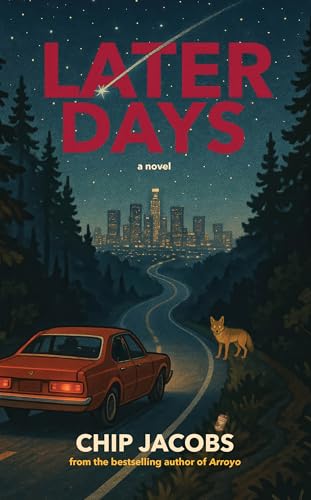
Later Days
by Chip Jacobs
Expected release date is Sep 16th 2025 from Rare Bird Books
Blurb: In an evocative follow-up to his Los Angeles Times bestselling Arroyo, Chip Jacobs returns with a gripping tale of brotherhood, recklessness, and footloose souls in the anything goes of late-seventies Southern California.
As their elite, all-boys prep school turns coed, transforming from suburban Lord of the Flies to gender-roiled soap-opera, two unlikely friends—Luke Burnett and Denny Drummond—alternate rescuing each other from self-destruction amid troubled home lives. Eager to maximize their era as invincible seniors at Stone Canyon Prep, they and their pals commandeer Bob’s Big Boy, explore the secret world beneath Caltech, stumble into a possibly-supernatural lab animal, and grapple with near-ODs at a playoff game. Just as our heroes manage to graduate, their bond is shattered by a wild gunshot that’ll haunt them for decades.
Twenty years later, Luke is a high-powered journalist with a nosediving career, while Denny, a visionary software engineer, is socked by a terminal diagnosis. Desperate to make amends for that coyote shot, Denny guilts his estranged friend into helping him, all climaxing with a Hail Mary bid to demystify mortality, with an assist from Elizabeth Kubler-Ross, while reconnecting with what matters most.
Later Days is a powerful exploration of the ties that bind and break us. Perfect for readers drawn to rollercoaster friendships, forgiveness, and the raw beauty of life skimming its edges to Near-Death Experience. With insight into Pasadena’s buried histories and the psychological baggage of growing up in the shadows of “Great Men” fathers, Jacobs’ second novel is as emotionally resonant as it is intellectually sharp.

“A classically intricate portrait of life in the 80’s, paired with the unique realities of the fictional teens within, Jacobs has created a lyrical coming of age mottled with the complexities and fragility of growing up. Later Days slowly builds the characters within from teens as they mature amongst the backdrop of suburban society through to some of their final days as they battle sorrow, sympathy, the path not taken, and the life that could have been.”—Jill Rey, For The Love Of The Page
Q&A – Chip Jacobs – forthcoming novel, Later Days
At what point did you decide to be an author, and what was your path to publication?
When I reflect back, I’m not so sure I decided to be a writer as much as something decided it for me. As a kid, the youngest son in a strange, often-lonely house, I was always reading. Always had a book open. It became my personal transportation device outside of those walls. Robinson Crusoe, The Three Musketeers, The Lords of the Rings trilogy, The Martin Chronicles: they introduced me to new worlds I couldn’t wait to inhabit. Later, when I got into junior high, English and history were easily my best subjects, and teachers early on encouraged me to pursue writing. Funny: not a single chemistry or calculus teacher ever advised that.
What do you do when a new idea jumps out at you while you’re still working on a book? Do you chase the squirrel (aka “UP syndrome”) or do you finish your current project first?
I never chase squirrels, or as my agent would say, “fascinating rabbits” down holes until the timing lines up right. I try staying laser-focused on the job at hand, something I learned from my years in daily journalism. Instead of peeling away to develop something new, I bookmark or jot down germ concepts and circle back to them once I’ve wrapped up the project glowing on my computer screen.
Who is your favorite character to write, and why is that person your favorite? If picking a favorite character would be like picking a favorite child, which character seems to be the most demanding of your attention and detail as a writer?
This is a toughie, since I cherish writing all my characters. If I had to pick, however, I’d probably select: 1) characters based on me, because I can give them lives I never lived and imbue them with characteristics I wish I sorely lack. I also treasure conjuring scenes involving historical figures, once I’ve properly researched them. In my debut novel, Arroyo, that was Upton Sinclair (one of my boyhood idols) and Lillian Busch, the munificent wife of Budweiser beer-king Adolphus Busch. In my new book, Later Days, I created scenes around Richard Feynman, a Caltech, Nobel-Prize-winning physicist, and the venerable Dr. Elizabeth Kubler-Ross, one of the bold minds of the 20th Century. Being able to breathe life into these colorful figures is always electrifying. I find they usually have noteworthy things to express about the past that bear on our present. Or so I hope.
Describe your writing process. Do you outline, plot, and plan, or is your writing more organic?
Coming from the world of newspaper-reporting, and then non-fiction book writing, I was a disciple to the notion one always needed an outline as a blueprint for what spills onto the page. With my first novel, I clung to that, and was so anxious to chart every step in this limitless universe of fiction writing that I scratched out a thirty-thousand-plus-word treatment. By the juncture the book was complete, I’d harvested about twenty percent, if that of the original premise. In the sequel, Later Days, I abandoned over-planning for an outline under ten pages and character descriptions. Everything cascaded better, though undoubtedly I also was more confident in my chops. By the end of Arroyo, my characters were telling me what to do; with the sequel, those characters spoke to me sooner.
What have you found to be most challenging about writing?
Since I enjoy every facet, from inception to delivery, my biggest obstacle remains getting too close to my manuscript. So, when it comes time to do those last, final passes before manuscript submission, my brain tends to overlook the obvious. Typos, non-sequiturs, redundancies: my mind – or rather my eyes – lose their ability to pinpoint and flag those errors, meaning my manuscript can deceive me into believing it’s more polished than it really is. It’s got to be neurological (or psychological), where the author perceives one line on the page, possibly out of combo fatigue-excitement, while editors can discern fairly obvious mistakes. There needs to be a term for this variety of author blindness. I’m finetuning ways to correct that, starting with printing the manuscript out twice and reading it to myself.
Do you identify with your main character, or did you create a character that is your opposite?
Not only do I relate to my main character, but I believe it’s essential to conceiving well-drawn characters. When I’m stuck, I’ll close my eyes and try to imagine their sensory reactions and environment, and ask myself – if a character has overlap with me – how I’d navigate a certain situation. That main character, whether it’s the author’s alter-ego or partly based on someone you know, needs to be bred and nourished inside of you.
Describe the book or series in 10 words or less for people just learning about it.
In Later Days, two pals discover just what they’d sacrifice to rescue the other
What has been the toughest criticism you have received as an author? What has been the best compliment?
With Arroyo, a couple of readers commented with snark that my lead character wasn’t developed enough when I believed I’d done everything to enflesh him with idiosyncrasies, tics, backgrounds, contradictions, fears, desire-lines, and whatnot. It hurt, until I zoomed out and appreciated these were in the minority but I could still learn from them anyway. The best feedback I’ve heard? Easy. That my story resonated with them, or provided them with the entertainment or a measure of hope that lasted.
Share some advice for aspiring authors. What advice would you give to your younger self?
My advice would be to limit the outside voices of people suggesting, often unsolicited, what to write and how to pull it off. The best literary advice I’ve heard came from The Bard himself in “Hamlet”: “to thine own self be true.” Another gem, and this one riffs off Toni Morrison: when in doubt, write the book you’d want to read. Speaking of that, you can’t do better than devouring Stephen King’s tremendous non-fiction literary guide/memoir: On Writing. To me, the best final line ever hailed from the incredible (and criminally unappreciated) Pete Dexter. In “Paperboy,” he leaves us with this truism: “No man escapes intact.”
About the Author
Chip Jacobs is a genre-crossing author and prize-winning journalist. His first novel, Arroyo, about Pasadena, California’s mysterious Colorado Street Bridge, was a Los Angeles Times bestseller, CrimeReads most anticipated book and Independent Book Publisher Award honoree. Among his other books are the international bestselling Smogtown, which he co-wrote with William J. Kelly and is under development for a streaming series, the acclaimed black-comedy, true-crime story,The Darkest Glare, and the Indies Book of the Year Finalist, Strange As It Seems. Jacobs’ reporting and subjects have appeared in the Los Angeles Times, The New York Times, The Wall Street Journal, Marketplace, CNN, LA Weekly, and the Los Angeles Daily News and elsewhere. Learn more at chipjacobs.com.
Note: Some posts may contain affiliate links. Should you choose to purchase a product, we will receive a small commission for the sale at no additional cost to you. Chapter Break is a participant in the Amazon Services LLC Associates Program, an affiliate advertising program designed to provide a means for sites to earn advertising fees by advertising and linking to Amazon.com.

Love the cover on this one! I enjoyed reading the interview as well. As an aspiring write I always like to read how authors who have published books get it done.
Lisa Mandina (Lisa Loves Literature) recently posted…E-galley Review: Ghost Business (Boneyard Key #2) by Jen DeLuca