

The story of the author as a young woman coming of age in an Irish Catholic, military family…


Author: Mary Lawlor
Publisher: Rowman and Littlefield
Pages: 323
Genre: Memoir
Format: Hardcover, Paperback, Kindle, Audiobook
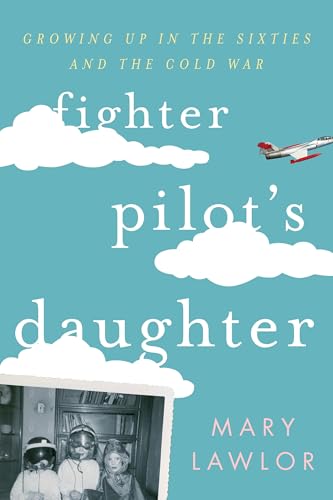
Fighter Pilot’s Daughter: Growing Up in the Sixties and the Cold War tells the story of Mary Lawlor’s dramatic, roving life as a warrior’s child. A family biography and a young woman’s vision of the Cold War, Fighter Pilot’s Daughter narrates the more than many transfers the family made from Miami to California to Germany as the Cold War demanded. Each chapter describes the workings of this traveling household in a different place and time. The book’s climax takes us to Paris in May ’68, where Mary—until recently a dutiful military daughter—has joined the legendary student demonstrations against among other things, the Vietnam War. Meanwhile her father is flying missions out of Saigon for that very same war. Though they are on opposite sides of the political divide, a surprising reconciliation comes years later.
Fighter Pilot’s Daughter is available at Amazon.

Here’s what readers are saying about Fighter Pilot’s Daughter!
“Mary Lawlor’s memoir, Fighter Pilot’s Daughter: Growing Up in the Sixties and the Cold War, is terrifically written. The experience of living in a military family is beautifully brought to life. This memoir shows the pressures on families in the sixties, the fears of the Cold War, and also the love that families had that helped them get through those times, with many ups and downs. It’s a story that all of us who are old enough can relate to, whether we were involved or not. The book is so well written. Mary Lawlor shares a story that needs to be written, and she tells it very well.” ―The Jordan Rich Show
“Mary Lawlor, in her brilliantly realized memoir, articulates what accountants would call a soft cost, the cost that dependents of career military personnel pay, which is the feeling of never belonging to the specific piece of real estate called home. . . . [T]he real story is Lawlor and her father, who is ensconced despite their ongoing conflict in Lawlor’s pantheon of Catholic saints and Irish presidents, a perfect metaphor for coming of age at a time when rebelling was all about rebelling against the paternalistic society of Cold War America.” ―Stars and Stripes


The pilot’s house where I grew up was mostly a women’s world. There were five of us. We had the place to ourselves most of the time. My mother made the big decisions—where we went to school, which bank to keep our money in. She had to decide these things often because we moved every couple of years. The house is thus a figure of speech, a way of thinking about a long series of small, cement dwellings we occupied as one fictional home.
It was my father, however, who turned the wheel, his job that rotated us to so many different places. He was an aviator, first in the Marines, later in the Army. When he came home from his extended absences—missions, they were called—the rooms shrank around him. There wasn’t enough air. We didn’t breathe as freely as we did when he was gone, not because he was mean or demanding but because we worshipped him. Like satellites my sisters and I orbited him at a distance, waiting for the chance to come closer, to show him things we’d made, accept gifts, hear his stories. My mother wasn’t at the center of things anymore. She hovered, maneuvered, arranged, corrected. She was first lady, the dame in waiting. He was the center point of our circle, a flier, a winged sentry who spent most of his time far up over our heads. When he was home, the house was definitely his.
These were the early years of the Cold War. It was a time of vivid fears, pictured nowadays in photos of kids hunkered under their school desks. My sisters and I did that. The phrase “air raid drill” rang hard—the double-A sound a cold, metallic twang, ending with ill. It meant rehearsal for a time when you might get burnt by the air you breathed.
Every day we heard practice rounds of artillery fire and ordinance on the near horizon. We knew what all this training was for. It was to keep the world from ending. Our father was one of many dads who sweat at soldierly labor, part of an arsenal kept at the ready to scare off nuclear annihilation of life on earth. When we lived on post, my sisters and I saw uniformed men marching in straight lines everywhere. This was readiness, the soldiers rehearsing against Armageddon. The rectangular buildings where the commissary, the PX, the bowling alley, and beauty shop were housed had fallout shelters in the basements, marked with black and yellow wheels, the civil defense insignia. Our dad would often leave home for several days on maneuvers, readiness exercises in which he and other men played war games designed to match the visions of big generals and political men. Visions of how a Russian air and ground attack would happen. They had to be ready for it.
A clipped, nervous rhythm kept time on military bases. It was as if you needed to move efficiently to keep up with things, to be ready yourself, even if you were just a kid. We were chased by the feeling that life as we knew it could change in an hour.
This was the posture. On your mark, get set. But there was no go. It was a policy of meaningful waiting. Meaningful because it was the waiting itself that counted—where you did it, how many of the necessities you had, how long you could keep it up. Imagining long, sunless days with nothing to do but wait for an all-clear sign or for the threatening, consonant-heavy sounds of a foreign language overhead, I taught myself to pray hard.
– Excerpted from Fighter Pilot’s Daughter by Mary Lawlor, Rowman and Littlefield, 2013. Reprinted with permission.
What do you do when a new idea jumps out at you while you’re still working on a book? Do you chase the squirrel (aka “UP syndrome”) or do you finish your current project first?
When a new idea appears I note it down, or if I can’t, I try to remember it until I can get to my phone or find a pen & piece of paper. I’ll often create a (digital) folder and put the note in it, and when another thought related to that idea occurs, I’ll make another note and put that in the folder too. When I finally sit down to start working on the new project, I’ll have a collection of notes to look at while I’m clarifying the idea and sketching the plot. Generally I don’t let new ideas interrupt work on my current project.
Describe your writing process. Do you outline, plot and plan, or is your writing more organic?
My writing process is mostly what you call organic. I see a character or a couple of characters in a scene, or I hear a line of dialogue. After it’s lived in my head a while I start paying more attention to it and think about what else is in the scene. Then I stretch it out to imagine what the story might be.
When I’ve written about characters from history—people who actually lived—the story gets kicked off by a specific moment or image I’ve read about in that person’s life (or seen on film). It’s interesting how a sensory experience—watching the waves crash up against a sea wall in the city where someone lived; or the sight of their somber gravestone in the middle of an ornate chapel; or hearing a young woman shout across a busy street—can generate a whole story.
Fighter Pilot’s Daughter got started with a memory of an afternoon in the cement, basement-less house where we lived at Fort Rucker, Alabama. The house was hot and still. Suddenly a loud noise from the carport storage room blew up the silence. A batch of my father’s home brewed beer had exploded. My sisters and I crept out to inspect the damage, but the store room and the garage were fine. On the floor, the remnants of a dozen beer bottles lay scattered in pools of sour beer. My Dad was disappointed, but we weren’t. That beer meant nothing to us, except for the awful smell it left on his breath. But since he was unhappy, everybody’s mood shot down, and it wasn’t until cocktail hour that he and my mother started to feel better again.
This was one of the generative moments for the book. It made me remember viscerally how everything in our household went according to my parents, and especially my father’s, needs and interests. He and my mother were good to us—they praised and hugged us a lot; but my sisters and I inherited our mother’s deferential attitude toward Dad and men like him. The home brew was nothing to us, but since it was important to Dad, we had to pay attention, help out, and find the fun in it.
Tell us what you enjoy most about writing a memoir.
Writing a memoir was a great boost to my psychic life. Going through the memories and pushing them to go further and further back helped me to understand myself, as a girl and as a grown woman, a lot better than I did before. Thinking about the early days and remembering conversations, places where we lived, and friends we had, I also learned a good deal about my sisters. With the clearer pictures that came of myself and my siblings, I developed a more sensitive and empathic understanding of what my parents went through, bringing us up under the difficult circumstance of military family life during the Cold War years.
What have you found to be most challenging about writing a memoir?
The most challenging thing about writing Fighter Pilot’s Daughter was worry about what people who appeared in the book would feel when they read it. I changed names to protect their privacy, but my sisters’ names appeared as they were. I was especially concerned as to what they would think. I made clear in the introductory chapter that the book presented my story about our family history and that it wasn’t necessarily theirs. Of course, we had talked about events of our past many times, and we agreed on a lot of things; but on certain events our memories went in different directions. When the manuscript was finished I gave it to my sisters to look at, without promising to revise anything. If they’d objected to something, I might’ve changed it. On the other hand, I might not have wanted to, so I didn’t commit to that. As it turned out, they had no objections—at least none either of them wanted to share with me. But during the course of the writing, I was constantly aware of their thoughts and feelings.
Describe the book in 10 words or less for people who are just learning about it.
An American military family biography set during the Cold War.
Is there anything you would like people to take away from your book?
I’d like readers to know more about the experiences of military families—all the moves they make and how difficult it can be for the kids to shift from base to base, school to school, old friends to new friends. I also wanted to tell the story of the fear that played such a large role, especially on military bases, in daily life during the Cold War. The threat of nuclear war and the possibility of the Russians overtaking America made us so anxious they colored not just our parents’ speech but our dreams. It’s very strange to see the United States government now drifting into a cloudy friendship with the Russians, for reasons that aren’t explained to us citizens. Most of the parents and grandparents of the readers of this blog would be appalled to know of it.
To answer the question, I’d also like to quote from the end of my introductory chapter, titled “The Pilot’s House”:
My hope is that the pictures of military domestic life here will resonate with people born in the Cold War decades before 1980. And that in my story they will recognize those familiarly strange times—not just the fears but the dark enchantments that kept us down, ducking and covering, for more than forty years.
Do you have any odd (writing) habits?
I often write while peddling on a stationary bicycle! If I’m re-reading what I’ve written, I can keep peddling at a pace, but when actually writing, the peddling slows way, way down. My friends think this is totally weird, but it’s a way of keeping my limbs moving and my back loosened (I put a pack of three tennis balls against my lower back) while writing.
Share some advice for aspiring authors. What advice would you give to your younger self?
I would say first of all, if you have a yen to write, then write. Start doing it immediately. Don’t put it off, like oh I’ll do that a few years from now when I’ve finished with x. X being whatever job or project or school that has you in its grasp right now. You can always find time to write, and if you want to be a writer, you owe it to yourself to start right away and keep it up, every day—for an hour, twenty minutes, five minutes or whatever. This keeps your writing muscles alive and kicking, and eventually you’ll believe you’re a writer and produce things you’re proud of.
I’d also say listen to the words that sail through your mind when you sit down to write. You want to be a writer for several reasons, but one of those reasons is likely that there’s a lot of language dancing around in your head that you might not even know is there—single words, phrases, things people have said to you, lines from shows or films you’ve watched. They come to stay and want to be heard, so listen to them and use them. And this is true when you’re editing your work as well. You start reading one of your own sentences, and a voice in your head finishes it, but it’s not the same as what’s there on the page. Chances are, you should follow the wording of the voice, not what’s on the page. Let the voice in your head tell you how to revise your work.
What is your favorite line from your book?
My favorite line from Fighter Pilot’s Daughter is the first one: “The pilot’s house where I grew up was mostly a women’s world.”
To date, what is your favorite (or most difficult) chapter you have ever written?
What a great question. The Paris chapter called “Showdown with Jack,” Chapter 24 of Fighter Pilot’s Daughter, was one of my favorites. It’s where my father comes back from Vietnam to find me at the American College of Paris. It’s a complicated story, and I’ll leave it to the book to explain, but it was a tense moment for both of us. Writing that chapter, I came to understand my own stubbornness and my father’s fears much more deeply. It was good to go back to the memory of that scene in the dean’s office at the American College and my father standing in the doorway with his long-distance gaze. I saw the dean’s desk, and the fluorescent lights, my father’s suit. My own bitten fingernails. Revisiting the moment was like going into therapy: seeing my Dad where he wasn’t supposed to be, after what I’d been through, was a traumatic experience, and I’m grateful for the time I spent writing that chapter.
What do you like to do when you’re not writing?
I like to swim, and I swim a lot, at least three times a week, usually 40 laps. My parents threw us into the pool at the Marine Corps Base in Miami when we were really young and got us taking swimming lessons as soon as we were old enough. My older sisters and I took synchronized swimming lessons when we were kids. Later, we got out of school for performances. I was just a little kid and liked wearing the costumes and the lipstick, but my older sisters were really good swimmers and could do amazing things in the water. I was never as good as they were, but I still swim laps faithfully.
I also like to hike. We live half the year in the mountains of southern Spain, where the hiking’s great, and we go out with friends for hours at a time. The climbing can be steep and the downgrades too, but it’s great fun. Afterwards we go out for something to eat and celebrate.
Apart from swimming and hiking, I read, like a lot of you who follow this blog. I’ll read three or four books at a time. Sometimes I read very slowly, because I relish sentences and will read one over and over and over again to get the rhythm of it and follow the writer’s word choices and syntax. Then I’ll start reading that same book fast. Certain novels have magical styles that captivate readers, but they also just pick you and up and carry you along, like Roddy Doyle’s Paddy Clarke Ha, Ha, Ha, Paul Murray’s The Bee Sting, Perceval Everett’s James, or Anna Burns’ Milkman. I also like reading history, especially ancient and medieval history. I’m fascinated with the people who went before us and the worlds they built, the things they left behind for us to see and wonder about. I did a lot of that in writing a novel I just finished, set in 12th century Spain, titled The Translators. I hope to see it out in print next year.

Mary Lawlor is author of Fighter Pilot’s Daughter (Rowman & Littlefield 2013, paper 2015), Public Native America (Rutgers Univ. Press 2006), and Recalling the Wild (Rutgers Univ. Press, 2000). Her short stories and essays have appeared in Big Bridge and Politics/Letters.
She studied the American University in Paris and earned a Ph.D. from
New York University. She divides her time between an old farmhouse in
Easton, Pennsylvania, and a cabin in the mountains of southern Spain.
You can visit her website at https://www.marylawlor.net/ or connect with her on Twitter or Facebook.


Note: Some posts may contain affiliate links. Should you choose to purchase a product, we will receive a small commission for the sale at no additional cost to you. Chapter Break is a participant in the Amazon Services LLC Associates Program, an affiliate advertising program designed to provide a means for sites to earn advertising fees by advertising and linking to Amazon.com.


Love the cover on this one! Also enjoyed once again reading the author’s writing process. Thanks so much for sharing!
Lisa Mandina (Lisa Loves Literature) recently posted…Lisa Loves to Discuss #9 – Authors or Series I Keep Saying I Need to Read (But Still Haven’t)