
Stealing from Wizards
Date Published: 11-04-2025
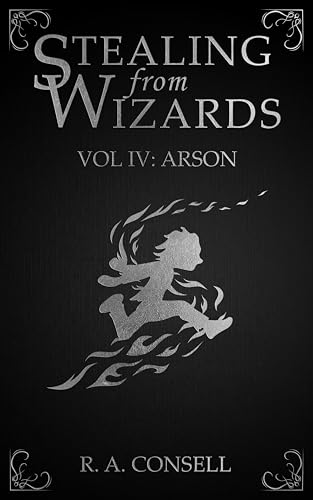
½ wizard teenager) remains at Avalon Academy for more magical mayhem,
reluctant heroism, and poorly-timed duels. Trapped on the Academy’s
island for a summer of make-up classes, he stumbles into a dangerous mystery
that could reshape the world. Between dodging dragons, unraveling
conspiracies, and baking cookies for creatures, Kuro must confront who he
is—and who he wants to be. As the new school year begins, old enemies
rise and magical chaos spreads, Kuro’s past and future collide in a
final adventure that’s as heartwarming as it is exciting.
Guest Post: Write for an Audience of Two
There is endless advice out there about how to write to a particular audience. You can find countless commentaries on what romance readers want, what fantasy aficionados expect, and the nuanced differences between hardboiled and cozy mysteries. What these usually come down to, though, are analyses of genre conventions. Valuable as that knowledge may be, it will not tell you if anyone will enjoy your book.
To have confidence that your work has a real audience, one that will love and appreciate your work, my experience is that it’s best to write for exactly two people.
I’ve been a writer for a long time, but my writing stepped up a level when I recognized a flaw in my process. Annoyingly, I noticed it at my day job.
I found that I could sometimes create truly excellent prose in scenarios that did not deserve that level of craft: emails to colleagues, instructions to students, powerpoint slides, that sort of mundane dross. I would occasionally come out with really tight descriptions, potent metaphors, and sharp witticisms which eluded me in my other writing.
The difference, I came to recognize, was my audience. When crafting an email or presentation, I knew who I was making it for. Not in a general sense, but personally. I knew who they were, what they liked, their sensibilities and senses of humor. I could write directly to them. My fiction was being written to an imagined, amorphous future audience.
I started writing specifically for my partner. She’s the person I know best in the world, so I could tailor my work to her. I don’t have to imagine what someone might like, I know what someone does like. I know what makes her laugh, what makes her tear up. I know how she communicates, and what references and metaphors she’ll connect with.
Let me tell you, that simple change made a drastic improvement in my writing. My earnest advice to anyone since is to find that person to write for. Pick someone who will delight in your story, who enjoys the genre you’re playing in, and make them the focus of your work. It will strengthen your craft and make it more consistent. If nothing else, even if your novel never sees the light of day, it will have entertained that one human.
I claimed at the start that you should write for exactly two people, and I have only mentioned one. I will not be the first to argue that the second person must be yourself. Worrying too much about your audience and forgetting the artist is a pathway to drudgery. If you don’t love your work, it will show in the craft. It will be bland and lifeless, and more than likely it will never get finished. Without a love of your own story, every chapter will be a marathon in a headwind. Many an author has chosen a project based on things like market research instead of personal passion, and produced pablum or just abandoned the joyless work midway.
So from my experience, target two readers: yourself, and one single specific person you know well. If you have an audience of two who love your work, then there are guaranteed to be others.
About the Author
mathematics, stage actor, armorer, and nerd culture activist. His work has
been featured on io9, Kotaku, Boingboing, MTV Geek, madartlab.com and in Game
Developer Magazine. He is an internationally acclaimed theorist on the science
of fiction. He has consulted on such titles as “The Science of Game of
Thrones,” spoken at events including DragonCon and Convergence, and partnered
with the American Chemical Society. He employs his background in materials
science and engineering to overthink fictional physics and to make science
more accessible to the public. Ryan was born and raised near Toronto. He has
lived and worked in Tokyo and Vancouver, but currently calls Ontario home.

Note: Some posts may contain affiliate links. Should you choose to purchase a product, we will receive a small commission for the sale at no additional cost to you. Chapter Break is a participant in the Amazon Services LLC Associates Program, an affiliate advertising program designed to provide a means for sites to earn advertising fees by advertising and linking to Amazon.com.

Leave a Reply