
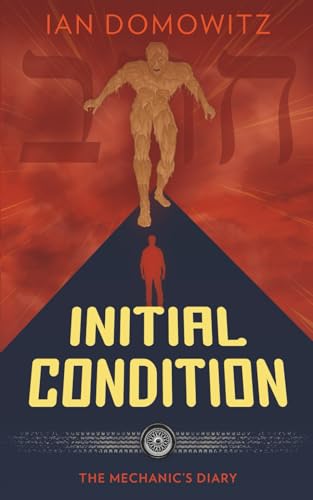
 Initial Condition (The Mechanic’s Diary)
by Ian Domowitz
Genre: Supernatural/Fantasy
Format: Paperback, eBook
Page Count: 170
Publisher: Casa Muerte Press
Pub Date: September 16, 2025
ISBN: 9798299435443
“He condemned the living for the crime of existence.”
A twelfth century vision of artificial intelligence foreshadows a sixteenth century recipe to produce it. A nineteenth century prison nurtures it. A twenty-first century golem befriends it. And a boy without a century stands at the intersection of real and virtual,
moments into the future. They call him The Mechanic.
A kidnapping leads Hanzi Boss to a sanctuary community where religious law forbids speech by the artificially intelligent. For beings like him, the penalty for existing is death and his true nature must remain secret. But the community has its own secrets. An ancient immigrant hides there, a monster made not born, a being who can know Hanzi for what he really is. When the price of life is death, who survives—infinite strength steeped in the silence of the past, or intelligence guided by lived experience?
This is a story of arcane knowledge, alchemy, and strange philosophies. It is the story of a being not created by God, who does not know what he is and searches for something more. Initial Condition is the third book in The Mechanic’s Diary series following Wake the Whirlwind and Neurojuggler.
A completely engrossing, creative story that toes the line between magical realism, dark fantasy, philosophical and social inspection, and an exciting foray into human and AI potential.” —Midwest Book Review
“A reality-bending mix of mysticism and alchemy… Domowitz blends biblical lore with concepts of moral responsibility and accountability in this visceral exploration of humanity, free will, and spirituality… Ultimately, Domowitz’s imaginative allegory explores the search for truth and identity alongside the value of arcane wisdom versus lived experience.” —Publishers Weekly


Author Interview
At what point did you decide to be an author, and what was your path to publication?
I published as part of careers in academia and Wall Street, everything from op-ed length pieces to fifty-page research reports. Along the way, I wrote Four Laws for the Artificially Intelligent, about means by which AI changed company culture. For reasons known only to my publisher at the time, the book came out within weeks of The Age of AI by Henry Kissinger, Eric Schmidt, and Daniel Huttenlocher. My book was buried, of course, but that was not what bothered me. Their work was another example of fusing hashed-over history with some (quite good) predictions about the future and calling it nonfiction. Once upon a time, we labeled such short stories, science fiction. It was then that I decided to be a fiction author, an important distinction, I think. I’ve been writing about AI ever since.
What do you do when a new idea jumps out at you while you’re still working on a book? Do you chase the squirrel (aka “UP syndrome”) or do you finish your current project first?
When I take more than a day or two off from a book, I lose touch with the characters. I finish the current project, modulo maybe jotting down a few notes in an off instant. If the idea plays like an earworm, it may find a mention in the story of the moment. I’m only now starting a book called The Privacy Wars but have called out the event in earlier novels from the time I first thought about it.
Who is your favorite character to write, and why is that person your favorite? If picking a favorite character would be like picking a favorite child, which character seems to be the most demanding of your attention and detail as a writer?
Hanzi Boss, the mechanic of The Mechanic’s Diary series. He is a being imagined as an AI in a human body, not created by God, who does not know who he is and searches for the answers in human lived experience. We all want to read and write about what we are and could be. Fiction is a marvelous mirror for the human condition and its dreams. Hanzi is coming of age in a human society of which he knows little more than a large language model would from ingesting text and pictures. What purpose would such a being have? How would he live? I find such questions fascinating.
Like Martha Wells’s Murderbot Diaries, the Mechanic series begins as a series of novellas about consciousness. In a short-form novel, there only is room for a single POV, the point of view of the main character, absent a narrator. All other characters close to the protagonist in story terms must arc emotionally and show depth even if we are never inside their heads. That makes all such roles demanding of attention and detail. In Initial Condition, a Jewish mother proved the most difficult. Without spoilers, her arc is a twist in and of itself, which made it all the harder to follow.
Describe your writing process. Do you outline, plot, and plan, or is your writing more organic?
Neither. Both. I cannot keep an entire outline in my head, but I don’t trust words to simply come, either. I try to devote a small amount of time in the evening to what I’m going to write next day and make a few notes, but not an outline. The notes are questions I want to answer as I write the next couple of thousand words or so. A mystery novel takes more planning, if you want to credibly hide the guilty parties or the why of it from the reader. Poe says we should always know how the story ends in order to infuse it with the right emotional quality. It is advice that I resonate to but find difficult to follow.
Regardless, some structure is necessary if you are, as Stephen King said, sailing a bathtub across the Atlantic. I rely on Blake Snyder’s “fifteen beats” from his Save the Cat screenwriting book, scaled to novella or novel length in terms of a reader’s time on the page. So my outline consists of constraints: not a point at which Colonel Mustard chooses a candlestick but rather a period in the storyline during which they may or must do so. All stories must make time for testing the promise of the story’s premise, for the bad guys to close in, and for the hero to be cast down without hope of recovery before making use of what they learned through the b-plot and winning the day. Making sure that all happens is a discipline.
A factoid you can skip but I cannot resist: That it does happen in literature generally was the topic of Kurt Vonnegut’s failed 1959 master’s thesis at the University of Chicago. I find the failure consistent with the slow adoption of Joseph Campbell’s 1949 Hero’s Journey guide to writing. It is now the standard in storytelling. And AI-driven results have made good on Vonnegut’s conjectures.
Have you been able to incorporate your previous experience in your jobs/education in your writing?
It’s inevitable but varied. I spent a few years in commercial kitchens in the beginning, and menus were a feature in early Getz Parker mysteries. Parker himself is a fintech guy, like I was but sufficiently different to be written as wealthy. I worked in machine learning one way or another for decades and have the artificially intelligent as narrators and characters, avenues to explore larger themes and entertain at the same time.
Do you identify with your main character, or did you create a character that is your opposite?
Neither. I am reminded of a scene in the movie, Inception: “Never recreate places from your memory. Always imagine new places…because building a dream from memory is the easiest way to lose your grasp on what’s real and what’s a dream.”
Too much entrenched lived experience can be a liability. Our default setting is our own perspective, and we accept enough about ourselves to constrain the possibilities of a character.
Describe the book or series in 10 words or less for people just learning about it.
The Mechanic’s Diary is:
Adventures of a spiritual leader not created by God
or
A serial allegory of one AI’s search for the Singularity
The choice of which one to use depends on who’s in the elevator when I make my pitch.
What is your favorite line from your book?
“He was capable of condemning the living for the crime of existence.” Unpacking that phrase is the key to understanding the entire book.
To date, what is your favorite (or most difficult) chapter you have ever written?
A scene in Initial Condition that spans a bit more than a chapter qualifies in many ways for both. It is a symbolic wedding in which two female golems come together for the first time in a virtual reality. I thought of the kiss in Amirpour’s The Outside for the visual: unsettling, blatantly sexual; part seduction, part surrender, part psychological collapse. And in my case, physical collapse and death. Much of the book has been building to this moment. All the undercurrents are manifested through the two witnesses to the act, one a rejected lover and the other the protagonist who has made the meeting possible to their own ends.
What has been the toughest criticism you have received as an author? What has been the best compliment?
The following captures some of both. It came from my editor (everyone needs one), referring to a particular passage but on a general theme she has described more than once:
“My impression is that you know how the sentences are connected, but don’t want to spell it out for the reader.
“Some writers worry that if they spell things out too much, the prose will come off as “too obvious” or sound unintelligent. I’m not sure if that’s a concern you have, but if it is, there’s no need to worry. You’re dealing with lots of fascinating, complex subject matter, and you can only gain by making it clearer. Readers will be most engaged if they can understand what’s happening.
“Or is there something else operating here—some other reason for ordering the words and sentences in this particular way? This novel, like the others that take place in its universe, is deeply concerned with secret codes, specific words and arrangements of letters that have great power. Could there be an underlying structure that the reader isn’t made aware of?
“In the passage above, it feels as if the sentences probably have logical connections that are known to the writer and just need to be explained to the reader; but it also feels possible they aren’t meant to be logically connected. Interested to hear your thoughts on this!”
About the Author
Note: Some posts may contain affiliate links. Should you choose to purchase a product, we will receive a small commission for the sale at no additional cost to you. Chapter Break is a participant in the Amazon Services LLC Associates Program, an affiliate advertising program designed to provide a means for sites to earn advertising fees by advertising and linking to Amazon.com.

This is a new book to me. Definitely sounds like an interesting premise. Thanks for sharing the author interview, I always like hearing about authors’ processes.
Lisa Mandina (Lisa Loves Literature) recently posted…Favorite First Lines # 11 – December 2025