
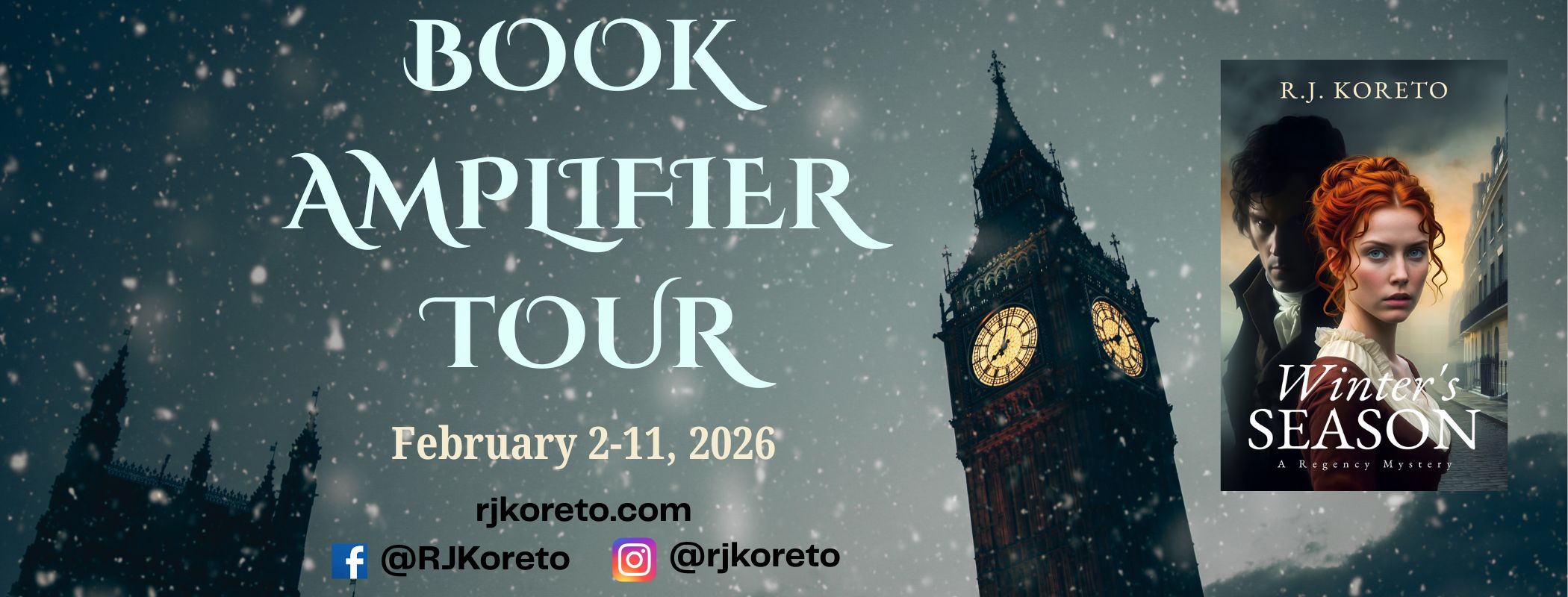
The story of Winter’s Season by R.J. Koreto follows a man asked to act where others cannot. Captain Winter’s work exists in the margins, shaped by discretion rather than recognition.
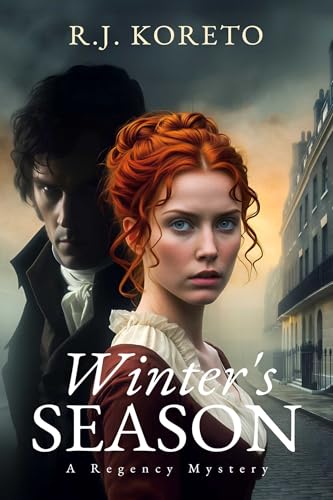
Winter’s Season: A Regency Mystery by R.J. Koreto
Captain Winter’s role as Whitehall’s unofficial emissary places him in cases meant to remain unseen. When a young woman is murdered, his investigation uncovers resistance at every level.
A nobleman from his childhood offers access to elite circles, while a brilliant Jewish physician brings insight grounded in reason. The return of Barbara Lightwood, a former lover whose intelligence and discretion give her proximity to sensitive information, complicates the investigation. Her guarded cooperation unsettles Winter’s judgment and raises the stakes.
With each step forward, Winter confronts justice as a solitary and unforgiving pursuit.
Amazon: https://bit.ly/4oGUp00
Goodreads: https://www.goodreads.com/book/show/235788930-winter-s-season

Author Interview:
What sets your book apart from others in your genre?
In Winter’s Season, both the actual mystery and the relationships between the characters tightly relate to the rigid social structure of the day. What kinds of behavior were acceptable from the nobility as opposed to the commoners? What could men do that women couldn’t—and vice versa? Those all deeply affect the investigations. Captain Winter, my protagonist, is a rare figure who doesn’t belong to any class—or perhaps he belongs to all of them! Unmoored, he tries to find his place in the world as he tracks down a killer.
What’s your favorite compliment you’ve received as a writer?
I wrote a series of books about Lady Frances Ffolkes, a spirited and unconventional suffragette in Edwardian England who finds the time to become an amateur detective. A reader wrote to me: “I wish Lady Frances was real so she could be my friend.” That something liked my character so much!
Why did you choose this setting/topic?
I read Pride & Prejudice with a professor who had done her dissertation on Jane Austen. She stressed one line in particular, about the deceitful Mr. Wickham: he “wanted only regimentals to make him completely charming.” That stayed with me for a long time! All the details that make up how we are seen—so essential in that time period. My protagonist, Regency-era Captain Winter, is a very different man from Wickham, but he also finds that uniforms cover a lot. And clothing aside, behavior remains behavior. Jane Austen’s characters realize that—and so do mine!
Which author(s) most inspired you?
For the nuts and bolts of assembling a mystery, no one beats Agatha Christie. She wrote the book…on how to write the book! When it comes to setting a scene, I go with Georges Simenon’s Maigret novels. I could read them only in translation, but I still found his ability to set a mood, to set a scene with memorable characters, remains unparalleled. For dialog, I love Ngaio Marsh’s Nero Wolfe tales. It’s a goal of mine to create as lively exchanges as Archie Goodwin has with his boss.
And number one for me is John le Carre. Most people are surprised to hear this, because I don’t write spy thrillers. But I remain amazed at his ability to explore the complexities of love and hate, of loyalty and betrayal, and so much more. His themes are both peculiar to the Cold War and universal. That is ultimately what I want to achieve, to bring home the same thematic power—and subtlety—as Le Carre.
Which 3 books would you bring to a desert island?
Ooh! Do multivolume sets count? I’d like the complete works of Sherlock Holmes, The Lord of the Rings Trilogy, and Murder on the Orient Express.
Which character or real-life person surprised you the most while writing this book, and why?
My protagonist, Captain Winter, developed depth as I wrote about him. I try to follow Stephen King’s advice about letting characters have their own way. In the first chapter, I have Winter smoothly navigating an upper-class London dinner party. He leaves to make his way to a low tavern—where the regulars are terrified of him—and proceeds to track down a serial killer in a grim slum, displaying an appalling ruthlessness that stuns even his own men. Then it’s back to his rooming house where he meets his landlady’s visiting niece—a sweet farmgirl who inexplicably charms him. I found myself using the rest of the book to show why this happened like this. Who is this man with his extraordinary physical strengths, his shrewdness–and his war-damaged soul? Can he finally find his place in the world?
Tell us about a moment during the writing process when the story (or message) took an unexpected turn.
I partnered Winter with a woman as mysterious—and dangerous—as he is: Barbara Lightwood. Like Winter, she won herself a place in Society. In one discussion, he wonders why a woman he was talking to seemed so desperate. “We’re all desperate,” she snaps back. When I wrote that, it became a theme: A domestic servant sees a stint as a rich man’s mistress as her only chance for a better life. And women from wealthy and well-connected families find themselves equally stuck, to marry someone of their class, to live just one kind of life. The book started with Captain Winter navigating England’s complex class structure—but he also found himself coming up against long-established gender roles. Will he change his mind? Can he?
What’s something you had to research, learn, or experience to write this book that genuinely shocked you?
Over the years I’ve done a lot of research into British policing for my books. Scotland Yard has become a symbol of policing, but actually London was late to the policing game. The British felt that a formal police force would become a tool of government repression—an argument we’re still having! (Remember Inspector Javert from Les Miserables?) It took wily politician Robert Peel to finally convince the English to create a police force in 1829. By then, the terrible crime rate made a police force essential. So when I chose to set my book in 1817, I had to face the fact that London—one of my favorite cities—was probably a crime-ridden nightmare. Captain Winter, I realized, would have his work cut out for him!
About the Author:
R.J. Koreto has been a merchant seaman, book editor, journalist and novelist. He was born and raised in New York City and decided to be a writer after reading “The Naked and the Dead.” He and his wife have two grown daughters and divide their time between Rockland County, N.Y., and Martha’s Vineyard, Mass. Visit R.J. at his website and on Facebook and Instagram.
Note: Some posts may contain affiliate links. Should you choose to purchase a product, we will receive a small commission for the sale at no additional cost to you. Chapter Break is a participant in the Amazon Services LLC Associates Program, an affiliate advertising program designed to provide a means for sites to earn advertising fees by advertising and linking to Amazon.com.


Leave a Reply