
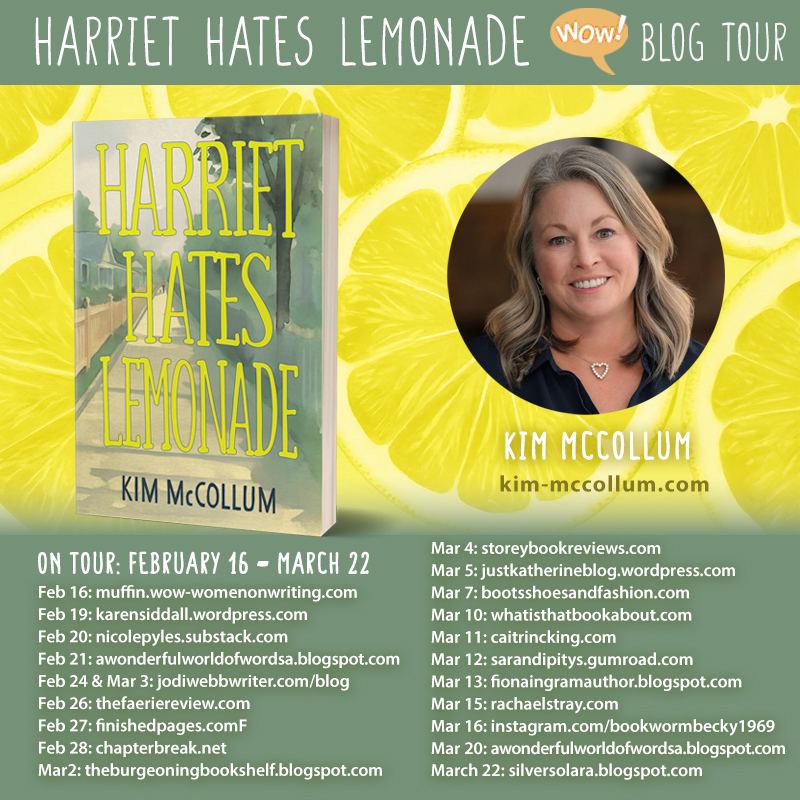
Harriet Hates Lemonade by Kim McCollum

Book Summary
Meet Harriet. But don’t be surprised if she isn’t interested in meeting you.
Harriet has life all figured out, and she doesn’t hesitate to inform others of their shortcomings. Though her attempts to become president of the homeowner’s association failed, that doesn’t stop her from berating “off-leash-dog-man” or reporting the neighbor who had the audacity to leave their easter decorations up an entire week past the holiday. The problem is, unbeknownst to her, Harriet’s rigid rules and judgmental opinions are not her own.
Her ordered life plunges into chaos when a twelve-year-old neighbor knocks on Harriet’s door seeking help because the girl’s father is physically abusing her mother. Reluctantly, Harriet comes to her neighbor’s aid and, in the process, recognizes her own insidious abuse which has unwittingly shaped her isolated, rigid existence. To escape her crushing loneliness, she must learn to break free from the patterns of control and isolation that have defined her life and learn to connect with people she previously viewed as heathens.
Publisher: Black Rose Writing
ASIN: B0G2YPGWHV
ISBN-10: 1685137059
ISBN-13: 978-1685137052
Print Length: 312 pages
Purchase a copy of Harriet Hates Lemonade on Amazon, Barnes and Noble, and Bookshop.org. Be sure to also add it to your GoodReads reading list.

Excerpt from Harriet Hates Lemonade
One such day, years ago, she’d donned her favorite sundress, the light blue one with the small daisies, and set out hoping to make a good first impression. Her mother told her about never having a second chance.
Harriet started with her closest neighbor, right next door. Watching discreetly from the dining room window, she’d learned they had two little girls, around two and four. On the pie delivery day, Harriet waited until they’d been home a half an hour to let them settle in a bit and then made her way to their front porch and rang the bell.
From behind the door Harriet heard, “Elizabeth, how dare you! Get over here!” The smile she’d readied for the encounter slid from her face. Figuring this wasn’t a good time, Harriet turned to leave. The door swung open. From her dining room window, this woman had appeared around thirty, and attractive, despite her rather frumpy clothing, but up close, she appeared to be closer to fifty. The creases on her forehead were so deep they didn’t disappear even when she relaxed her scowl.
“Can I help you?” the neighbor asked.
“Well, you see,” Harriet said, “I’ve baked you a pie. I hope you like apple.”
“Thanks,” the woman said, taking the pie.
They stood staring awkwardly for a moment. Harriet assumed she’d be invited in, that they would have a cup of coffee or tea. Harriet thought this happened when you spent a day baking pies for your neighbors in a perfect neighborhood like theirs was.
“I live next door. Just there,” Harriet said, pointing.
“Okay,” the woman said, running her hand through her messy hair. Then nothing. A child yelled, “Mo-om, Katie pulled my hair again!”
The woman sighed. “Well, I’ve got to go. Thanks again!”
The door shut. Harriet stood staring at it. She hadn’t even learned the woman’s name.
Author Guest Post: How to Use Setting to Develop Your Story
I believe living in Montana gives me a huge setting advantage, although I suppose I could be a bit biased. Montana is vast, rugged, and unapologetically tough, which makes it the perfect setting for the strong, resilient, and often quirky characters I love to write. Being surrounded by a landscape this powerful forces a certain kind of grit to the surface. Setting can be so much more than just a beautiful backdrop. It can be an incredibly useful tool for character development.
In my debut, What Happens in Montana, I leaned into the unsettling environment of a haunted hot springs to reflect a group of women dealing with a ghostly mystery. In Harriet Hates Lemonade, I wanted to use an uptight Bozeman neighborhood with strict HOA rules to mirror Harriet’s inflexibility.
Harriet Henderson is a woman who uses rigidity as a survival mechanism. To develop her character, I placed her in a meticulous neighborhood with matching fences and zero tolerance for anything that shows the messiness of life. The setting reflects her internal world. If the outside looks perfect and controlled, she can pretend the inside is, too. There is tension in watching her try to maintain her rigid composure while hobbling on crutches through snow and ice and struggling to keep her dog under control. (The weather never stops Montanans, so yes, she would walk her dog while on crutches in the snow.) She knows the neighbors are watching from behind their matching curtains, and she refuses to let the Montana weather, or her own physical vulnerability, make her look like she’s lost her grip.
The best settings have a public face and a private reality. The neighborhood in Harriet was inspired by a place I once lived that looked like Mayberry from the outside, but underneath was surprisingly uptight. Additionally, it was a stark contrast to the wild, untamed peaks of the Bridger Mountains that loomed just beyond our driveways. I believe this contrast highlights Harriet’s desperate attempt to control the uncontrollable. By clinging to her rigid rules and tidy neighborhood, she tries to build a sanctuary in the shadows of Montana’s untamable peaks.
As a writer, I look for those points of friction. By placing Harriet in a world that obsesses over trash can placement and closed garage doors, the setting reinforces her worst instincts and justifies her isolation.
Whether I’m exploring modern-day Bozeman or digging into the gritty history of the gold rush for my upcoming novel, I always look for the tension between the landscape and the people. I sometimes ask myself: How does this environment shape my character or force them to change?
In Montana, the setting isn’t just where the story happens. In many ways, it’s the reason the characters have to be so strong. When I think of my setting as a mirror of some aspect of my character that I want to highlight, my setting shifts from being a simple description of a place to a deep exploration of the human spirit.
About the Author
Kim McCollum graduated from Barnard College with a major in Japanese and was soon navigating the hustle and bustle of Wall Street. When her first child was born, she stayed home to raise her children. Once they headed off to school, Kim finally found time to pursue her passion for writing. Her award-winning debut novel, WHAT HAPPENS IN MONTANA, was published in January 2024, and her short stories have appeared in several publications. She lived in Bozeman, Montana, with her supportive husband, Brian, and their blended menagerie of five kids and three spoiled pets.
You can find her online at:
Her website: https://kim-mccollum.com/
Twitter: https://x.com/KFMcCollum
Facebook: https://www.facebook.com/kimmccollumauthor/
Instagram: https://www.instagram.com/author.kimmccollum/
Note: Some posts may contain affiliate links. Should you choose to purchase a product, we will receive a small commission for the sale at no additional cost to you. Chapter Break is a participant in the Amazon Services LLC Associates Program, an affiliate advertising program designed to provide a means for sites to earn advertising fees by advertising and linking to Amazon.com.


Leave a Reply