
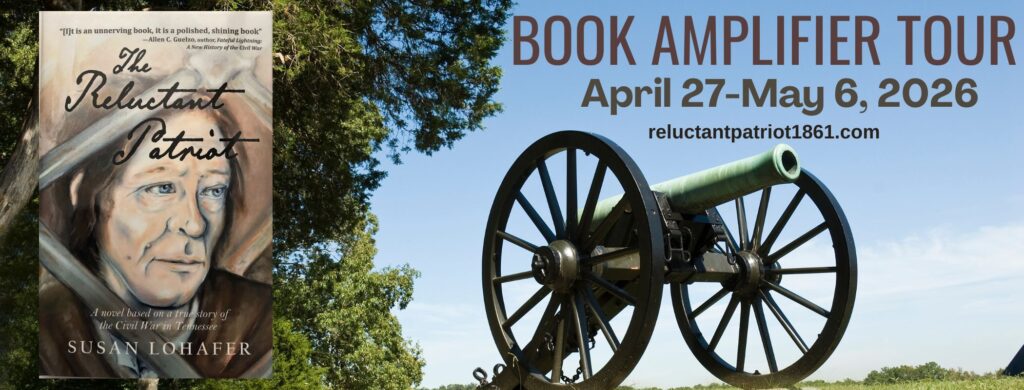
The Civil War didn’t divide every place along clear lines. In some communities, it settled in more quietly—reshaping relationships, testing loyalties, and turning ordinary moments into something uncertain. In The Reluctant Patriot, Susan Lohafer follows one man trying to stay outside of that shift as it gradually reaches his doorstep.
[easyazon_image align=”center” height=”500″ identifier=”B08XSMTW7S” locale=”US” src=”https://m.media-amazon.com/images/I/51KFb+HRnVL._SL500_.jpg” tag=”chapbrea05-20″ width=”329″] [easyazon_link identifier=”B08XSMTW7S” locale=”US” tag=”chapbrea05-20″]The Reluctant Patriot: A Novel Based on a True Story of the Civil War in Tennessee[/easyazon_link]
Set in East Tennessee during the Civil War, the story unfolds in a region where Unionist and Confederate loyalties existed side by side, often within the same families. Harrison Self, a farmer committed to remaining neutral, believes he can avoid the conflict by focusing on his home and livelihood.
That sense of separation is disrupted when his son becomes involved in a Unionist conspiracy to burn Confederate railroad bridges. The act sets off a chain of arrests, investigations, and growing suspicion that moves quickly through the community.
Accused of treason, Harry is drawn into military courts where justice is uncertain and outcomes hinge on what others are willing to say. In a setting defined by mistrust and shifting allegiances, he must navigate a system that offers little clarity. As the pressure builds, the story examines how neutrality can be redefined under scrutiny, becoming something that invites suspicion rather than safety.
[easyazon_infoblock align=”none” identifier=”B08XSMTW7S” locale=”US” tag=”chapbrea05-20″]
Amazon: https://bit.ly/4tKQ5zy
Goodreads: https://www.goodreads.com/book/show/55704809-the-reluctant-patriot
Author Interview
What’s a detail, theme, or clue in your book that most readers might miss on the first read but you secretly hope someone notices?
On p. 190, Andy explains how he escaped from captivity while in transit to another prison. After losing himself in a crowd, he was helped on his way by Lincoln-loving slaves, among whom was a child in a “red stocking cap.” Andy, of course, doesn’t know who the child is, but readers, I hope, will recognize Joshua, the narrator of Chapter 5, with his distinctive Zouave cap. His cameo reappearance advances the untold story of his growing awareness of his agency as a human being and his stake in the Civil War.
When did this story or idea “click” into place for you—was there a single moment you knew you had to write it?
A few years after I moved to East Tennessee, I happened to be leafing through some books on local history. I already knew that this part of the state had been loyal to the Union, even after Tennessee joined the Confederacy. As a transplanted Northerner, I was drawn to this anomaly. When I chanced upon the case of an ordinary citizen who was caught in the war unwillingly and sentenced to death for treason, I knew I held a thread that would lead me to the heart of a fascinating story.
Which character or real-life person surprised you the most while writing this book, and why?
Ask people about W. G. Brownlow, the famous pastor, editor, and first governor of Tennessee after the Civil War, and they’ll probably tell you, yes, he was charismatic, but also bumptious, mud-slinging, didactic, and vengeful. As I got to know him better, however, I learned he was other things, too: generous, warm-hearted, courageous, and faithful (in his way) to the dignity of the common man. I loved the challenge of portraying this controversial figure.
If your book had a soundtrack, what three pieces of music would be on it and what scenes or moments would they pair with?
– Stravinsky’s Rite of Spring (finale), heightening the drama of the bridge-burning frenzy, p. 28.
– Jay Ungar’s “Ashokan Farewell” (Ken Burns’ documentary), marking the transition between the Prologue and Chapter 1, pp. 3f.
– Dvořák’s New World Symphony (the part adapted by William Arms Fisher as “Goin’ Home”), underscoring Andy’s dying vision of the escape to Kentucky through the Cumberland Gap, pp.196f.
What’s one belief, question, or emotional truth you hope readers carry with them long after they finish your book?
I hope that, years after meeting Harry and sharing his inner life, readers will remember that patriotism isn’t an easy or automatic feeling. It’s a learned understanding, sometimes at great cost, of your identity’s debt to your country’s past, present, and future.
Tell us about a moment during the writing process when the story (or message) took an unexpected turn.
This book began, many years ago, as a work of nonfiction about a Civil War incident. Some of the earlier chapters were shopped around to agents, but no one was interested. I had to admit it: I’d lost interest myself. In the kind of writing that exhilarated me, in the short stories I’d published in the past, the subject wasn’t separate from the artistry that rendered it. At heart, I was a fiction-writer. I wanted to tell a story that was faithful to the record yet open to the imagination. And so I began writing an historical novel about a reluctant patriot.
If your protagonist (or central figure) could give the reader one piece of advice, what would it be?
One of the many things Harry lost during the war was his confidence that he had a handle on life’s challenges, so he wouldn’t have been quick to give advice. If pressed, however, and given that his greatest sorrow was not his own suffering at the hands of the Confederacy but the death of his son, I think he would have said, Listen for what your children aren’t saying to you.
What real-world place, object, or memory helped shape a key element in your book?
In 1861, Lick Creek was a minor stream crossed by a major bridge. Over it, the railroad carried the resources of the Deep South to the generals of the Confederacy. When I visited the spot in a quiet corner of rural Tennessee, there was no trace of the railroad that was sabotaged by local Unionists. The long grass was still there, and the low-hanging branches, and the clear brown water above a velvety streambed. Later, I populated that scene with stamping horses and low-voiced men, stirring up the fallen leaves and muddying the water as they stealthily neared the bridge they would soon destroy, along with their innocence as noncombatants.
What’s something you had to research, learn, or experience to write this book that genuinely surprised you?
When researching the Tennessee State Guard (often disparaged as Governor Brownlow’s “private army,” used to harass his enemies), I was surprised–and moved–to learn that some of these soldiers were assigned to protect Black voters on their first Election Day after emancipation. I’d thought that suffrage, like other rights, could be granted by fiat, but it only came into being through the choices men made when it came under threat.
If your book were invited to join a shelf with three other titles, which ones would make you happiest—and what would that shelf say about your story?
I’d be thrilled to see my book on a shelf with Geraldine Brooks’ March (2005), Allen C. Guelzo’s Gettysburg: The Last Invasion (2013), and Charles Frazier’s Varina (2018). Being in such company would say not only that my book is set during the 1860s, but that–politics and generalship aside–books about war should always come down to the sufferings endured and the meaning found (or lost) by those experiencing it firsthand.
About the Author
Susan Lohafer is the author of The Reluctant Patriot, a historical novel based on true events from the Civil War in East Tennessee.
A graduate of Harvard University (B.A., magna cum laude), Stanford University (M.A. in Creative Writing), and New York University (Ph.D. in American Literature), she spent her academic career at the University of Iowa, where she specialized in short fiction theory and narrative structure.
Her previous books include Coming to Terms with the Short Story and Reading for Storyness: Preclosure Theory, Empirical Poetics, and Culture in the Short Story, as well as the co-edited volume Short Story Theory at a Crossroads. Her shorter works have appeared in publications such as The Southern Review, and a 2011 essay was on the ‘Notable’ list in The Best American Essays.
She lives in Tennessee.
Visit Susan at her website.
Discover more from Chapter Break
Subscribe to get the latest posts sent to your email.

Leave a Reply