
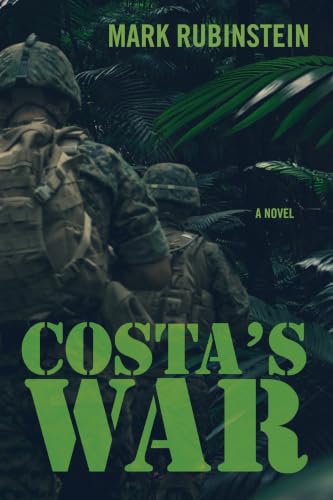
Mark Rubinstein on Costa’s War
(Thunder Lake Press, November 10, 2026)
Blurb: Right after college graduation, Costa, a lower-middle-class kid from Buffalo, New York, is drafted into the US Army and plunged into the Vietnam War. Costa’s War catapults the reader back to the conflict that changed America.
This is a compelling novel of morality–right or wrong in a split second in the hell of the jungle–when it really matters, regardless of rank, military orders, or rule books. It asks how a soldier survives, how he deals with dislocation, and how he reacts when given an order that defies everything he’s ever believed about the human soul.

Author Interview
Author Interview: Mark Rubinstein, author of Costa’s War
What inspired you to revisit the Vietnam War through fiction in Costa’s War?
When I wrote the novella The Foot Soldier, I was reflecting on my own army service (I did not serve in Vietnam), but I thought it was time to write a novella describing what so many of our young men went through in the 1960s and 1970s. During much of the conflict, I was a member of the U.S. Army reserves, and there was the constant threat of my unit being activated. So, in a vicarious way, I identified with those who’d been drafted to serve in that war. I was also struck by the hostility expressed toward returning veterans of that war, and felt a story about a lower-middle-class kid forced to serve would provide a poignant portrait of what many of those young men endured both during the war and afterwards.
Costa’s War expands on your award-winning novella The Foot Soldier. What made you want to return to Costa’s story and develop it further?
When The Foot Soldier was published, it received hundreds of reviews on Amazon. One of the recurrent themes of many reviews was readers’ desire to learn more about Costa and what he went through. Readers wanted to know how the war affected him; they wanted to know what his life was like after his active service came to an end. Readers asked for a deeper and more comprehensive portrait of jungle warfare and its effects on the foot soldiers who fought under the most extreme circumstances imaginable.
Do you identify with Costa, or is he a character who feels very different from you?
Whenever I write about a protagonist, especially if I’m writing in the first person, I think and feel the way he does. In a sense, I become that protagonist. After all, everything he thinks and feels comes from within me and is a product of my own thoughts and feelings. I can’t imagine writing a novel like Costa’s War without virtually becoming Costa. It might be called channeling the character, or in a way, losing my own sense of self. I think that probably describes every author to one degree or another.
How have you been able to incorporate your previous professional and educational experiences into your writing?
I don’t consciously try to bring my psychiatric education, training, and experiences to my fiction. Instead, I put myself in the persona of the protagonist and use what I know and feel as a sentient human being when I write. To some marginal extent, I use some of my experiences in fashioning a novel: for instance, my own army experiences helped me write with some authenticity about the experience of a soldier. But I avoid trying to use my clinical knowledge of psychiatry in the service of telling a story. When it comes to writing, I’m nothing more than a storyteller.
Why was it important to you to focus not just on combat, but on the moral choices soldiers face under extreme pressure?
Warfare is perhaps the most extreme form of danger and moral conflict for most people. Aside from the fear of death and dying, the pressure of wartime conflict thrusts the soldier into a moral dilemma. It’s kill or be killed, and it’s difficult to imagine anyone with a sense of human awareness being unaware of the horror into which one is catapulted. As for storytelling, I felt it was important to present Costa as a fully rounded person and not a “stick figure.” He has an abiding awareness of the fragility of his life under the duress of the jungle; he is frighteningly aware of being thrust into a situation of mortal danger; and is fundamentally a decent human being thrust into a hellish situation over which he has no control. It’s the fate of every soldier involved in wartime combat.
How did you approach capturing the fear, exhaustion, uncertainty, and constant vigilance of life in the jungle?
The fear, exhaustion, uncertainty, and constant vigilance of life in the jungle seemed inevitable to me. I imagined myself trying to cope with “humping the bush” and used my own sense of fear of the unknown (which I think is a universal fear) in telling Costa’s story. Costa’s War is the fiction of mortal events. The sense of dislocation and the horror of the jungle, along with the constant threat of death, were certainly enough to create the atmosphere so prevalent in the novel.
What do you hope readers take away from Costa’s War?
Above all, I wanted to tell a story that would impress the reader with the horror of war and the fact that even when the shooting stops, the effects of combat continue to one degree or another for the rest of a soldier’s life. I also wanted to describe a war that, in its own way, changed the way Americans think about war. I hope that after reading the novel, a reader will have not only a deeper appreciation of what happened during that war, but will also have a better understanding of the madness of war.
About the Author
Mark Rubinstein is an award-winning author, former forensic psychiatrist, and U.S. Army veteran. After earning a degree in business administration from NYU, he served in the U.S. Army as a field medic caring for paratroopers of the 82nd Airborne Division. Following his military service, he returned to school, earned his medical degree, and became a psychiatrist.
Rubinstein went on to practice forensic psychiatry, serving as an expert witness in numerous trials. He was also an attending psychiatrist at New York-Presbyterian Hospital and a clinical assistant professor of psychiatry at Cornell, where he taught psychiatric residents, psychologists, and social workers while maintaining his psychiatric practice.
Mark Rubinstein is the author or co-author of 26 books, both fiction and non-fiction. His novella The Foot Soldier won a Silver Benjamin Franklin Award, Return to Sandara received a Gold IPPY Award for Suspense/Fiction, and The Lovers’ Tango won a Gold Benjamin Franklin Award for Popular Fiction. His most recent works include A Lethal Question, Peril on West Tenth, and Costa’s War.
Discover more from Chapter Break
Subscribe to get the latest posts sent to your email.

Leave a Reply