A practice of noticing | Beau James Thomas
A blank page can be intimidating for both a reader and an artist. A sketchbook seems to demand a drawing, while a notebook held beside a novel seems to demand something clever about the plot. I have found it more useful to give both pages a smaller job: notice one thing. The page does not have to explain the whole world. It only has to hold a detail long enough for us to return to it.
As a visual artist, I often begin with a form, edge, color, or interruption that catches my attention. A painter may find an entire composition in the shadow beneath a staircase or in the way lettering sits on an old storefront. A reader can work similarly. One sentence, an odd gesture, or an unanswered question can linger long after the chapter ends. That lingering sensation is worth collecting, even if we cannot yet say why it matters.
The reader’s notebook and the artist’s sketchbook share a useful refusal: neither has to be a finished argument. A sketch might be a box around a shape and three words in the margin. A reading note might be a question rather than an interpretation. The joy is in preserving curiosity before our minds hurry to make it tidy.
A detail is not a summary
Summarizing a chapter can tell us what happened. Noticing asks what made that experience particular. Instead of writing “the character was lonely,” we might copy a brief phrase that suggested loneliness, then add our own observation about an empty chair or a window left open. Instead of drawing an entire street, we might mark how the sidewalk bends around a tree. In both cases, the detail stays small enough to remain alive.
A note like “blue wall, chipped paint, afternoon light” can be more useful to a painter than a long explanation of a building. A reader might write, “Why does the narrator never describe the kitchen?” Both observations create a path back to the work. They also reveal something about the observer. The questions we choose are part of our creative voice.
Let the notebook disagree with you
I like leaving room for a second visit. Our first reaction to a character can be confident and completely wrong. A visual impression can change when we revisit the same place at a different hour. In a notebook, I can write “I think this means…” and return later to write “Or perhaps…” The page becomes a record of thinking rather than a performance of certainty.
This is especially important when we read about real places or people. The first explanation we encounter is rarely the only one. I write about local art histories, and I am interested in the details that a postcard or a familiar landmark cannot tell us by itself. Attention can open the door to further research, other voices, and a more generous understanding of a place.
A ten-minute practice
Try this with the next book you read, whether it is a novel, memoir, or art book. For five minutes, read without pausing to annotate. Then close the book. On a blank page, make three small entries: one image you remember, one sentence or action that surprised you, and one question that has no answer yet. Draw a box, line, or quick symbol next to each entry. Artistic skill is not the point; the marks make the observations easier to find.
On the next reading day, return to those entries before you open the book. Has your question changed? Does the remembered image feel different? Add a second color, arrow, or sentence rather than erasing the first. Soon the notebook begins to show how your reading mind moves across a story, not just how a story moves from chapter to chapter.
The notebook as a place to return
There is no prize for filling every page or for making the margins elegant. A messy notebook that helps you notice more is doing its work. I encourage students and readers to leave space for unfinished thoughts because our most useful questions often arrive slowly. The sketchbook and the reader’s notebook are not tests. They are invitations to keep looking.
When I return to a drawing or a paragraph weeks later, I sometimes find that the smallest note is the one that matters most. It may be a color, a silence, or a sentence I had nearly forgotten. Keeping that fragment is a way of respecting the part of us that noticed it in the first place.
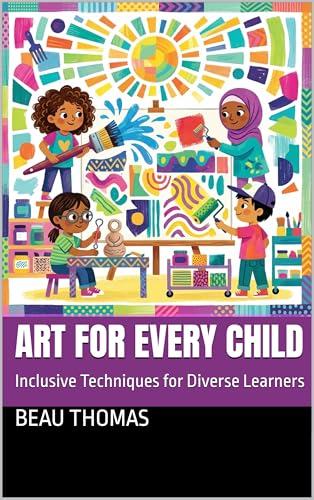 Art for Every Child: Inclusive Techniques for Diverse Learners (The Modern Art Classroom: Practical Guides for Inclusive, Creative, and Connected Art Education)
Book 1 of 18: The Modern Art Classroom: Practical Guides for Inclusive, Creative, and Connected Art Education
Author: Beau James Thomas
Blurb:Unlock the Creative Potential of Every Learner!
Are you ready to transform your classroom into a vibrant sanctuary of belonging? Art for Every Child: Inclusive Techniques for Diverse Learners is the definitive, high-energy guide for educators who believe that creativity has no boundaries. This isn’t just a teaching manual; it’s a manifesto for a revolution in the art room!
Step inside a world where barriers dissolve and every student—regardless of ability, language, or background—finds their unique artistic voice. Packed with cutting-edge strategies and soul-stirring inspiration, this book delivers:
- Game-Changing Adaptations: Discover how to pivot from “one-size-fits-all” to “design-by-default” using Universal Design for Learning (UDL).
- Sensory Magic: Master the use of adaptive tools and multi-sensory experiences that engage every sense and every soul.
- Cultural Empowerment: Learn to center your students’ heritage and traditions to create art that truly resonates.
- A Culture of Belonging: Build a classroom environment where empathy and innovation intersect, turning every project into a celebration of diversity.
Whether you are a veteran educator or a student teacher, this book is your essential toolkit for fostering equity and identity through the power of art. Don’t just teach art—ignite a movement of inclusion.

Author bio
Beau James Thomas is a California visual artist, author, and educator from Morgan Hill. He earned an MFA in Studio Art from Mills College and a BA in Visual & Public Art from CSU Monterey Bay. His work moves between public art, fiction, and cultural histories of overlooked places.
- Author site: https://beauthomasart.wixsite.
com/author-beau-thomas - Visual art: https://beauthomasart.wixsite.
com/beau-thomas-art-port
Discover more from Chapter Break
Subscribe to get the latest posts sent to your email.

Leave a Reply