
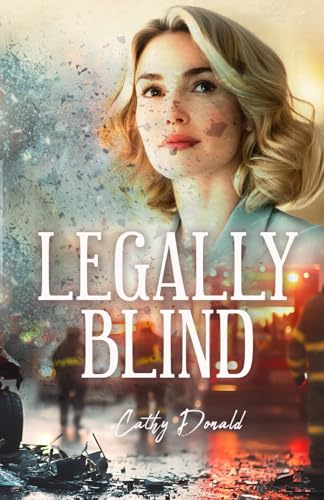
Cathy Donald’s thriller Legally Blind
Imagine being asked to defend the person responsible for the greatest loss of your life. You know what he did. You know what your family suffered. And now you may be the one person who can help him walk free.
For defense attorney Chelsea Turner, that nightmare becomes reality when she discovers that her newest client, Joel Radebe, was responsible for the bombing that killed her father when she was a child.
Joel was convicted, imprisoned, and eventually granted amnesty.
Now, decades later, he’s accused of murdering another woman, and Chelsea faces a choice no daughter should ever have to make.
Helping him feels like a betrayal of her father’s memory. But the more she learns about the new case, the harder it becomes to ignore the possibility that Joel is telling the truth.
As the investigation unfolds, Chelsea must confront the painful divide between what her heart wants, and what she believes is right.
Could you fight for someone you may never be able to forgive?
Set in South Africa, Cathy Donald’s Legally Blind blends legal suspense and murder mystery with an intensely personal moral dilemma that challenges the boundaries between justice, revenge, and forgiveness.


Author Interview
What’s a detail, theme, or clue in your book that most readers might miss on the first read but you secretly hope someone notices?
The Truth and Reconciliation Commission was set up to look at political crimes on both sides of the political spectrum. The hope was that people, especially victims, might be able to ‘forgive and forget’ but is this realistic? Forgiveness is a personal matter. Are people really able to offer it just because the country has deemed the slate to be clean? The book has a number of examples.
When did this story or idea “click” into place for you—was there a single moment you knew you had to write it?
I think often about the relationship between apartheid and the democratic South Africa in which we now live. I am curious about how much progress we have made as citizens and what factors have made us move on from those days. When I considered a previous ‘terrorist’, granted amnesty by the TRC and now accused of murder, I knew I had to write it.
Which character or real-life person surprised you the most while writing this book, and why?
Joel Radebe – the accused. His strength of character and resilience were amazing and inspirational.
If your book had a soundtrack, what three songs would be on it and what scenes or moments would they pair with?
“Fix You” (Coldplay) Played when Faye is sitting with Chelsea when she is in hospital after the bomb blast
“Glory” (Common and John Legend) Played when Joel goes through training to become a freedom fighter in the armed wing of the African National Congress
“Repeat It” (Martin Garrix and Ed Sheeran) Played when Joel and Blessing spend an evening together at their home – the evening the power goes off (A memory Joel has)
“Better Days” (One Republic) Played when Joel is in prison and/or immediately after his release
(I know that’s four but I got carried away with this!)
What’s one belief, question, or emotional truth you hope readers carry with them long after they finish your book?
We are often quick to judge people based on some action from their past. We don’t always see the motivation behind that long-ago action, and we sometimes don’t allow the person grace to grow and change before we judge them. So be slow to judge and quick to search for the truth.
Tell us about a moment during the writing process when the story (or message) took an unexpected turn.
When the murderer realises that he is cornered, he rapidly makes a plan to kidnap one of the lawyers in order to buy some time to tamper with evidence. It is a clever plan and nearly succeeds.
If your protagonist (or central figure) could give the reader one piece of advice, what would it be?
Chelsea would say, “Don’t jump to conclusions. Sometimes the solution is not the obvious one. Nor is it the one that you would like to believe.”
What real-world place, object, or memory helped shape a key element in your book?
All the courageous, frightening and devastating things that happened before democracy in South Africa, many of which happened in my lifetime – the Soweto uprising, the campaign of terror perpetrated by both sides of the political spectrum, and ultimately Mandela’s release from prison and the Truth and Reconciliation Commission.
What’s something you had to research, learn, or experience to write this book that genuinely surprised you?
I had to research the campaign of terror that was initiated before Nelson Mandela was released from jail and democracy took place in South Africa. The Wimpy Bar, a restaurant chain, was a target of many civilian attacks. Something that was interesting to me was that there was some evidence to suggest that many attacks on Wimpy Bars were perpetrated by apartheid agents in order to discredit the African National Congress.
If your book were invited to join a shelf with three other titles, which ones would make you happiest—and what would that shelf say about your story?
Cry, the Beloved Country – Alan Paton
To Kill a Mockingbird – Harper Lee
The Poisonwood Bible – Barbara Kingsolver
I would like to hope that the shelf would connect with Legally Blind in the following ways:
Cry, the Beloved Country, in that it is an exploration of a divided land pre-democracy and of how it comes to terms with the heartache of racial inequality with courage and resilience.
To Kill a Mockingbird, in that it is a story about a lawyer with tremendous moral courage, who fights against injustice – racial and class mainly – and teaches his children to value every human being.
The Poisonwood Bible, in that it explores the complexities of cross-cultural relationships and the impact of colonialism. It is also set in an African country.
About the Author
Cathy Donald is a South African novelist and former medical doctor. After qualifying in medicine in 1984, she practiced in both rural communities and urban private practice, most recently running a women’s health practice in Somerset West.
Alongside her medical career, she wrote scripts, music, and lyrics for amateur dramatic productions, particularly for schools and youth groups. She has since published multiple novels, many of them set in South Africa and centered on family, resilience, and the moral choices that shape people’s lives.
Her novel The Silence of the Shadows received the Jury Prize at the Milan International Literary Awards in 2022.
Discover more from Chapter Break
Subscribe to get the latest posts sent to your email.

Leave a Reply