
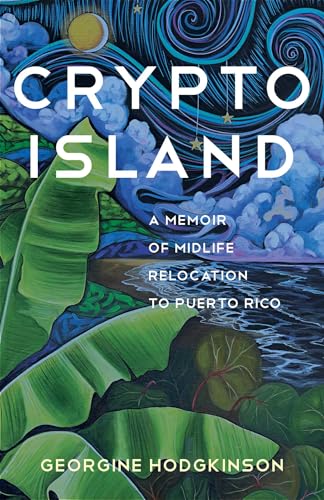
 Title: Crypto Island: A Memoir of Midlife Relocation to Puerto Rico
Author: Georgine Hodgkinson
Blurb: For fans of Stephanie Land and Glennon Doyle, a debut memoir of a woman who dives into cryptocurrency trading after relocating to Puerto Rico midlife—and along the way transforms her past struggles with poverty and substance abuse into wisdom.
Georgine had built a life of careful control. As a wife, mother, and college professor, she minimized risk and played by the rules. Her attorney husband was successful, her four grown daughters were thriving, and her students knew that hard work and deadlines mattered. Having survived a turbulent adolescence marked by poverty and substance abuse, she believed in the safety of well-ordered environments.
Then the pandemic upended everything. When classrooms and offices closed, Georgine and her husband Mark relocated to Puerto Rico, where she discovered a flourishing—and often outrageous—cryptocurrency community. As she navigated the mysteries of crypto trading and uncovered the political complexities woven into the fabric of the beautiful Caribbean island she now called home, Georgine embarked on a journey that would shatter her orderly existence—and force her to revisit the dangerous youth that had shaped her complicated relationship with home, risk, and money.
A memoir about facing past mistakes and embracing second chances, Crypto Island reminds us that personal growth never stops, and that living authentically often demands both resilience and reinvention.


Author Interview
At what point did you decide to be an author, and what was your path to publication?
My first published article dates back to 1992 — an academic piece on that year’s presidential election. As a college professor, I’ve had the chance to publish multiple research papers in the field of communication studies, and my interests are broad, ranging from analyses of political rhetoric to ethnographies in India. But I’d always wanted to write a book, and Crypto Island is my debut. This jump from writing for academic audiences to audiences at large has been thrilling and a little exposing — a research paper might reach a few hundred specialists, but a memoir means strangers will know things about me that even close friends didn’t.
What do you do when a new idea jumps out at you while you’re still working on a book? Do you chase the squirrel (aka “UP syndrome”) or do you finish your current project first?
Once I start a project, I’m determined to complete it. That doesn’t mean I don’t do a little squirrel chasing — I suppose all of us writers have a little Dug the dog in us — but I try to confine the new idea distraction to an afternoon. I make a file, save it, and reorient to my current writing project. If I let my inner Dug run wild, I’d never finish a darn thing!
Who is your favorite character to write, and why is that person your favorite? If picking a favorite character would be like picking a favorite child, which character seems to be the most demanding of your attention and detail as a writer?
My memoir takes place in Puerto Rico and spans the first year that my husband and I relocated to the island. Once there, we met others who had relocated for the same reason we had — tax and business incentives that make Puerto Rico a lightning rod for smart entrepreneurs in fields like finance and technology. But we also met more sinister folks, including an old mobster from whom we purchased our home. Sal Benozzo (not his real name) was a scary person but a wonderful real-life character to write. To purchase the property, Sal insisted we negotiate the deal without any agents, so long lunches — part negotiation, part socializing — filled many afternoons. After each encounter with Sal, I’d go home and write. From the gruesome stories he shared about mob life to his rancid sexist jokes, the material was rich.
Describe your writing process. Do you outline, plot, and plan, or is your writing more organic?
The answer is yes to both. I do spend time creating a general outline — I think it’s helpful to have some idea of where I’m headed with a book. Creating an outline, a plot, and a plan is critical to my process. But inevitably, as I write, the story takes me in unexpected directions. Since Crypto Island is a confessional memoir, some of the self-discovery happened in the process of writing itself. What I thought I knew about my past changed shape as I thought more deeply about the experience, so my outline endured many revisions.
What are some books or authors that you would recommend to our readers?
Once I started writing a memoir, I couldn’t get enough of reading others. I’m particularly attracted to memoirs where the writers show us their soft underbelly, where they share the sorts of things you’d never divulge at a dinner party. For me, the stuff worth writing about is deeply personal. Some of my favorites are The Many Lives of Mama Love by Lara Love Hardin, Lit by Mary Karr, Blow Your House Down by Gina Frangello, Untamed by Glennon Doyle, and The Chronology of Water by Lydia Yuknavitch.
Tell us what you enjoy most about writing memoir.
This is a tough question for me to answer because the list is long! But here’s my number one: universality. Of course, we all have different stories to tell, but the emotions underneath — the fear, grief, joy, and passion — are things we share. Writing and reading memoir connects us to each other and to the human experience. It reminds us that we’re not alone. The power of the human spirit is remarkable, and this genre teaches that lesson in spades.
What have you found to be most challenging about writing in memoir?
Vulnerability. It’s a prerequisite to writing memoir, but it never gets easy. Putting my life on the page, owning past mistakes, and sharing honestly about the things I’m most ashamed of as an adult is challenging. I’m not sure I could do it except that I’ve been teaching interpersonal communication for thirty years. One thing I know from teaching, from mentoring students for decades, is that we all have skeletons in our closets. A willingness to speak openly creates permission for others to do the same, and there’s real value in that kind of transparency — wisdom is gained when we’re honest about our life experiences.
Have you been able to incorporate your previous experience in your jobs/education in your writing?
Yes. Crypto Island takes place during a time when my teaching job was partially reassigned. In addition to my regular course load, I was running a program on my college campus called Re-Emerging Scholars, designed to support the needs of formerly incarcerated students. Working with these students changed how I thought about resilience. Despite all the obstacles they faced, their commitment to rewriting their lives through education never wavered — and that stayed with me. A handful of chapters in Crypto Island are drawn directly from that experience — not just the events, but that shift in perspective.
Do you identify with your main character, or did you create a character that is your opposite?
This is an interesting question for a memoirist, since we’re the protagonist in our own story. Because my memoir uses flashbacks to my adolescence, though, I’m able to write about a version of myself that no longer exists — one I have empathy for, but don’t relate to any longer. I was wild in my teens and twenties — I struggled with poverty, substances, and dangerous work. That version of me is very different from the woman I am today: a wife, mother, and college professor. Writing her was its own challenge — I had to resist the urge to judge her or explain her away, and instead let her make her own choices on the page without the wisdom I’ve gained since. In that sense, my main character is both me and not me — she’s who I was before I became who I am.
Describe the book or series in 10 words or less for people just learning about it.
A blend of facing past mistakes, midlife wisdom, and cryptocurrency.
To date, what is your favorite (or most difficult) chapter you have ever written?
Chapter Four in Crypto Island details a sexual assault I experienced at sixteen. This was by far the hardest chapter I’ve ever written. I almost didn’t include it in the book, but in the end, I decided it was important. Over many years of working with college students, I’ve learned that experiences like mine are all too common. Young women are often victims of this kind of violence, and I wanted them to know they are not alone. I also hoped they might learn from me that protecting your abuser with silence haunts you. Tell somebody.
What has been the toughest criticism you have received as an author? What has been the best compliment?
I worked with a terrific writing coach in the early days of writing Crypto Island, and every time I wrote about cryptocurrency, she would comment: “Crypto is boring! Trim!” My coach was in her seventies and had no idea what crypto was before working with me, so she wasn’t my typical reader. But her perspective was incredibly helpful to the book.
At first, I pushed back. I’d lived through the crypto boom — wasn’t that the story? Even though I find cryptocurrency a fascinating subject, I wanted my reader to feel the world I’d been living in. But my coach kept circling back to the same note, and eventually I understood what she meant: my expertise as a crypto trader wasn’t what made the book worth reading. My vulnerability was. So I was careful not to overload my reader with technical information and jargon — you only need to be crypto-curious to appreciate this book. My self-discovery as a woman in midlife mattered far more than my track record as a trader.
And that’s where my coach’s biggest compliment comes in: she cheered at the vulnerable stories I shared from my youth. That’s the writing that prompted Kirkus Reviews to call Crypto Island “brutally honest and deeply introspective, a courageous and powerful memoir.”
What do you like to do when you’re not writing?
Exercise is an important part of my daily life. I run, practice yoga, and play pickleball (I know — everybody plays pickleball these days, but dang, is it fun!). A healthy lifestyle is what energizes me and makes my busy life possible. In addition to being a writer, I’m a teacher, and when I’m not teaching, I love to travel with my husband. Last year we spent six weeks in Japan with dear friends, and it was fantastic! Along with the typical cultural experiences — visiting temples, eating delicious food, exploring museums — we also took a week-long bike trip through the countryside. A word of advice: if you plan to ride fifty miles a day, train first. Skip that step, like I did, and you’ll pay for it with one sore backside!
About the Author
Georgine Hodgkinson is a professor of communication studies at Cosumnes River College in Sacramento, where she also served as program coordinator for Re-Emerging Scholars, a program for formerly incarcerated students. Her published scholarship includes book chapters, journal articles, and essays exploring politics, gender, and spirituality. In 2025, she was a People’s Choice Winner for the Amy MacRae International Memoir Award. A certified yoga instructor who loves to run and play pickleball, Georgine splits her time between Dorado, Puerto Rico, and Folsom, California, with her husband, Mark.
Discover more from Chapter Break
Subscribe to get the latest posts sent to your email.

Leave a Reply