
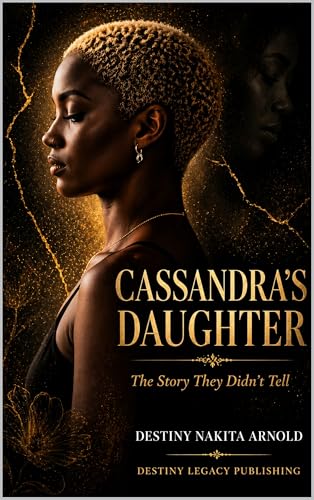
Book: Cassandra’s Daughter
Author: Destiny Nakita Arnold
Publication Date: August 8, 2026
Publisher: Destiny Legacy Publishing
Website: destinylegacyofficial.com
For years, her story was told without her.
Reduced to a single moment. Repeated without context. Remembered in a way that made it easier to judge than to understand.
But that was never the full story.
In Cassandra’s Daughter: The Story They Didn’t Tell, Destiny Nakita Arnold offers a deeply personal and unflinching account of growing up in the shadow of a narrative that was never fully hers to carry—but one that shaped her life in ways she would only come to understand over time.
Through memory, reflection, and hard-earned perspective, she revisits her mother’s life not to excuse what happened, but to restore the humanity that was left out of the version people chose to remember.
This is not just a story about loss, pain, or circumstance.
It is a story about:
• what children inherit from stories they didn’t create
• what it means to be seen through someone else’s past
• the weight of expectation—and the choice to rise beyond it
• and the power of telling the truth, even when it’s complicated
Honest, layered, and deeply human, Cassandra’s Daughter challenges readers to reconsider how they define people—especially when those people are no longer here to speak for themselves.
Because no life should ever be reduced to a single moment.
And some stories deserve to be told in full.

- Amazon Kindle Edition
View this post on Instagram
Author Interview
1. What moment or real-life event inspired you to write this book?
The idea for Cassandra’s Daughter really crystallized in 2025 during a family ancestry presentation. When my mother’s name came up, I noticed how quickly the conversation returned to her mistakes and the difficult parts of who she had been. It struck me that, even after her death, those were still the stories that seemed to define her.
Around that same period, I was also confronted with the fact that my mother didn’t even have a headstone or physical marker acknowledging that she had been here. Those things stayed with me.
I knew firsthand that Cassandra was not the mother I needed her to be. I lived that. But I began asking a different question. Instead of only asking, “What did my mother do to me?” I started asking, “What happened to my mother?”
That question changed everything.
I didn’t want to rewrite our history or excuse the things that happened. I wanted to understand the woman who existed before, during, and outside of being my mother. I wanted to make sure the worst things she had done weren’t the only things that survived her.
There was another reason, too. I wanted my children to have my account of our family history and my life. I didn’t want them someday trying to piece together who their grandmother was, who their mother was, or what shaped our family from everybody else’s version of the story.
Cassandra’s Daughter became my way of preserving that history while telling the truth about all of it.
2. Do you focus your writing toward a specific audience, or do you primarily write for yourself?
I think Cassandra’s Daughter began as something I needed to write for myself, but I always understood that its themes were much larger than me.
It is certainly for daughters and sons who have complicated relationships with their parents, but it is also for people who have loved someone dealing with mental illness, people carrying unanswered questions from childhood, and families where someone’s mistakes have become their entire legacy.
It is for people who are trying to understand where they came from without pretending the painful parts didn’t happen.
I think there is a difference between understanding someone and excusing them. I can acknowledge what my mother did and how it affected me while still wanting to understand what shaped her. Those two truths can exist at the same time.
So although this is my story and Cassandra’s story, I think there are a lot of people who will recognize pieces of their own families in it.
3. What was the research process like for this book?
Much of the reconstruction for Cassandra’s Daughter came from my own memories and conversations with my sister. My family did not know I was writing the book, so I wasn’t interviewing relatives or asking everyone to help me piece the story together. That was intentional. I wanted to write from what I remembered, what I experienced, and what my sister and I could recall from the life we actually lived.
I did ask one of my aunts for some photographs, although I never received them. Beyond that, I supplemented my memories by researching addresses, locations, newspaper articles, and other details that helped me reconstruct particular places and periods of our lives.
There was something powerful about that process because memory isn’t always neat or chronological. Sometimes you remember a house before you remember the address. You remember what happened in a neighborhood before you remember exactly where it was. Research allowed me to put some of those pieces back into their proper places without changing the emotional truth of what I remembered.
4. What challenges did you face while writing this book, and how did you overcome them?
One of the biggest challenges was allowing myself to tell the truth without feeling as though I had to choose a side.
For a long time, the easiest way to tell this story would have been to tell it entirely from the perspective of the daughter who was hurt. Those experiences are real, and I don’t minimize them in the book. Cassandra was not the mother I needed her to be.
But once I began asking what happened to her, rather than only what she had done to me, the story became more complicated.
I had to make room for empathy without turning empathy into an excuse. I had to acknowledge her humanity without erasing my own experiences. And I had to be willing to sit with the possibility that some questions would never have complete answers because she is no longer here to answer them.
I overcame that by allowing more than one truth to exist on the page. I could love my mother and be angry with her. I could acknowledge the harm and still have compassion. I could tell the truth about my childhood and still believe Cassandra deserved to have her own story told with dignity.
5. Is there a particular scene or passage in the book that you are especially proud of? Why?
It’s difficult for me to choose one particular scene because I’m proud of the book as a whole, but I am especially proud of every place in Cassandra’s Daughter where I was able to give my mother back some of her humanity.
I didn’t write this book to pretend Cassandra was a good mother. She wasn’t. There were things she did and things she failed to do that affected me deeply, and I wasn’t interested in rewriting that history simply because she is no longer here.
But I also came to understand that being a bad mother did not mean she stopped being a human being.
And her humanity wasn’t limited to understanding her pain or the difficult things she experienced, either. She had good times. She laughed. She had relationships. She had a personality. She had strength. She had an entire life. Cassandra was somebody’s daughter before she was my mother, and there were parts of her that existed outside of motherhood and outside of the hardest chapters of her life.
That became especially important to me because, for years, whenever her name came up, the conversation seemed to return to the same things: Cassandra was a lot. Cassandra was out there. Somebody always had to stand up for Cassandra. Those stories may be part of who she was, but they are not all of who she was.
And as her daughter, I got tired of that being the only version of my mother I was expected to hear.
The strength people have seen in me throughout my life had to come from somewhere, too. Nobody had to stand up for me. I learned how to stand up for myself. That fight, resilience, and determination were in me then, they are in me now, and they will continue to be part of who I am. And part of writing this book was recognizing that some of that strength may very well have come through her.
So whenever I was able to write about Cassandra with dignity, without excusing what happened to me and without reducing her to her mistakes or her struggles, I felt like I was accomplishing what I set out to do.
I could tell the truth about the mother I had while also telling a fuller truth about the woman she was.
Cassandra deserved honor. She deserved dignity. She deserved humanity. And she deserved to be remembered for more than the worst parts of her life.
6. How has writing and living with this project shaped your perspective?
It changed the questions I ask.
There was a time when so much of my understanding centered on what happened to me. Writing Cassandra’s Daughter forced me to look backward another generation and ask what happened before I entered the story.
That doesn’t change what I experienced. What it changes is the lens through which I understand it.
I have a greater appreciation now for how trauma, mental health, family dynamics, environment, and circumstances can travel through generations. I’ve also learned that understanding your history doesn’t require you to become trapped by it.
If anything, understanding it gives you more power to decide what continues with you and what stops with you.
I think that is one of the greatest things this project has given me: the ability to look at my mother’s life with greater humanity while looking at my own life with greater clarity.
7. Cassandra’s Daughter has grown beyond the book into community outreach and service. What does that evolution mean to you?
This may be one of the most meaningful parts of what has happened since the book was completed.
Cassandra’s Daughter began as a story about family, survival, memory, and legacy. But I didn’t want its impact to end when somebody closed the book.
On August 28, I returned to Atlanta, my hometown, and served at Atlanta Mission/My Sister’s House. There was something incredibly full-circle about that experience for me. I had once been a child searching for stability, and I was returning to the city that shaped so much of my story as a grown woman who was now in a position to help create a little stability, dignity, and care for someone else.
That’s when Cassandra’s Daughter began becoming more than a title to me.
The outreach work is about taking the themes of the book off the page. It’s about service, partnerships, volunteerism, and finding tangible ways to support people and communities.
I can’t change what happened in my childhood, and I can’t rewrite my mother’s life. But I can decide what I build from everything that came before me.
To me, that is legacy.
About the Author
Destiny Nakita Arnold is an author, publisher, entrepreneur, Navy veteran, and Founder and CEO of Destiny Legacy LLC. She is also the Founder of Destiny Legacy Publishing, an independent publishing company created to develop and preserve stories centered on identity, resilience, family, and legacy.
Her nonfiction works include Destiny Legacy: Becoming Her and Cassandra’s Daughter, released August 8, 2026. In Cassandra’s Daughter, Arnold examines her complicated relationship with her late mother while exploring family history, generational trauma, mental health, survival, and the distinction between understanding someone’s humanity and excusing the harm they caused.
Since the book’s release, Cassandra’s Daughter has begun evolving beyond the page into community outreach and service. In August 2026, Arnold returned to her hometown of Atlanta to serve at Atlanta Mission/My Sister’s House, beginning the next phase of the project’s mission to connect storytelling with tangible community impact.
Arnold’s work has continued to expand beyond traditional authorship. Through the Destiny Legacy platform, she has developed multiple literary and media projects, including Destiny Legacy Collective Newsletter and Destiny Legacy Collective Magazine, whose Founders Edition launches September 12, 2026.
Across her writing, publishing, and community work, Arnold remains committed to telling complicated stories with honesty while preserving the dignity, humanity, and legacy of the people within them.
View this post on Instagram
Official Website:
https://www.destinylegacyofficial.com/
Amazon Author Page:
https://www.amazon.com/stores/Destiny-Nakita-Arnold/author/B0H1JTTTLW
Goodreads:
https://www.goodreads.com/author/show/69519954.Destiny_Nakita_Arnold
Instagram:
https://www.instagram.com/misizarnold/
Facebook:
https://www.facebook.com/DestinyLegacyPublishing/
YouTube:
https://www.youtube.com/@DestinyNArnold
Discover more from Chapter Break
Subscribe to get the latest posts sent to your email.

Leave a Reply