
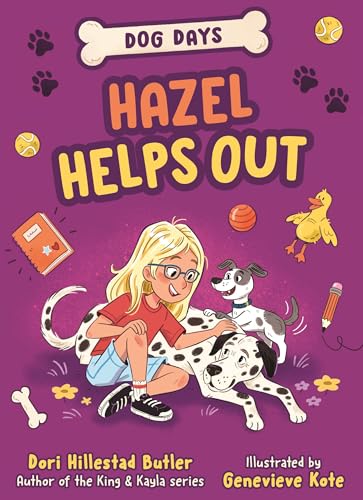
 Title: Hazel Helps Out (Dog Days)
Dog Days: Hazel Helps Out by Dori Hillestad Butler; illustrated by Genevieve Kote (Peachtree, for ages 6-9, on sale 10/27/2026)
Can Hazel find a new home, a place for herself, and a way to contribute to the family doggy daycare business?
Nine-year-old Hazel and her mother are facing some big changes. Grandma has been running Dog Days, a dog day care, all by herself for a long time, but now she needs some help—help that she doesn’t really want to accept. Hazel and Mom arrive for a visit that might turn into a long-term stay. First, they have to figure out what’s going on.
It’s hard to get prickly Grandma to tell them anything, about the business or her health. There are a lot of dogs to keep track of, including Houdini, who keeps them on their toes by repeatedly escaping. Hazel knows KC and Jonah, but they aren’t friends—at least not yet. And Hazel’s elderly dog Spot is having a hard time keeping up with the younger, more active dogs. If only there was a way to get everyone, young and old, to work together.
A Junior Library Guild Gold Standard Selection
“An appealing, doggedly upbeat tale.” —Kirkus Reviews
“A definite purchase for collections where Butler’s previous works are appreciated.”—Booklist


 Title: The Old Dogs' Club (Dog Days)
Dog Days: The Old Dogs’ Club by Dori Hillestad Butler; illustrated by Genevieve Kote (Peachtree, for ages 6-9, on sale 10/27/2026)
Hazel’s exciting new plan for the Old Dogs’ Club might be in trouble before it even starts. Can she find a way to get everyone to agree?
Hazel had a great idea: the Old Dogs’ Club, a program for seniors (like Hazel’s own dog, Spot) who are still up for some social interaction, mental stimulation, and exercise but can’t handle the intensity of the full day care environment.
Everyone is very excited, but as they start to plan, Hazel realizes they all have very different opinions about how to run the club. It was her idea, but Grandma vetoes a number of her suggestions, and it is starting to feel like KC and Jonah are taking over. But it’s hard to give up on a great idea, even when things get tough.
A Junior Library Guild Gold Standard Selection
“A bighearted summer story, both genuine and familiar.”—Kirkus Reviews
“Butler skillfully approaches each problem in turn and young readers will be caught up in learning how the characters handle relatable life situations and complex emotions.”—School Library Journal

AUTHOR INTERVIEW
At what point did you decide to be an author, and what was your path to publication?
I’ve always wanted to be an author. Always. But I went to college assuming I’d have some sort of day job or career and write on the side. I majored in English and child psychology but wasn’t sure what I would do when I finished college. I considered going on to graduate school in child psychology, I considered library school, I even considered law school. I was already married at this point, so my husband suggested I take a year to try writing. He had a good job and was willing to support us. He told me all those options would still be there in a year, but I would always wonder if I could have been a writer. This was a good time to find out. Before I sunk more time and money into grad school. So I took him up on the offer. I spent the next year writing full time and submitting my work to magazines, book publishers and agents. I didn’t get an agent that year. Or a book contract. But I sold two short stories and took that as a sign that I should keep going.
In the next few years, I continued to sell magazine stories, but no books. Not until I got hired as a ghostwriter for the Sweet Valley Twins series. I learned a lot writing Sweet Valley Twins books. It was like on-the-job training. And eventually, eight years after I started writing fulltime, I sold my first book. It was a picture book, which was great…but what I really wanted was to sell middle grade or YA novels. It was four more years before that happened. I submitted partials for two different middle grade novels to two different publishers on the same day. Both asked for the full manuscript about six months later, and then a few months later both offered contracts within one day of each other. Both novels came out in 2003, and I’ve had at least one new book a year almost every year since.
Slow and steady…that’s how I built a career.
What do you do when a new idea jumps out at you while you’re still working on a book? Do you chase the squirrel (aka “UP syndrome”) or do you finish your current project first?
LOL. I like that—the UP Syndrome. I know you’re referring to the movie UP and how the dog is always chasing the squirrel. But I like the idea of chasing an idea UP rather than DOWN. I tend to think in terms of going DOWN the rabbit hole. Up has a much more positive connotation, doesn’t it?
But I digress. I keep a binder of ideas in Scrivener, so when that shiny idea jumps in front of me and threatens to derail me, I can sort of corral it into a cage (aka a folder in that idea binder) while I finish the current project. I’m usually under contract for the current project and don’t have the time to chase the shiny idea. But that’s fine because I know the idea isn’t going anywhere, and it needs time to “bake” anyway.
Who is your favorite character to write, and why is that person your favorite? If picking a favorite character would be like picking a favorite child, which character seems to be the most demanding of your attention and detail as a writer?
When kids ask “what’s your favorite book you’ve written,” I always respond, “that’s like asking me to choose between my children” and I explain how each of my children is special for different reasons etc., so it surprises me that when you frame the question this way, I do have an answer.
My favorite character to write is King, the lovable golden retriever who tells the King & Kayla stories. He’s happy, loyal, earnest, suffers from the “UP Syndrome” in a big way because he lives in the moment. He’s so much fun to write, and I love being in his head.
It’s been different (hard?) writing about him as a side character in the Dog Days series. I’m not in his head; I’m in Hazel’s head. And Hazel barely knows him. I’ve enjoyed living with Hazel and would be happy to write more books about her, but I wonder if it’s because I’ve now had the experience of writing King from the outside rather than the inside that I realize I do have a favorite character. Something to think about…
Describe your writing process. Do you outline, plot, and plan, or is your writing more organic?
I outline, plot and plan. Before and during the project. Sometimes even into the revision process. I wish I was more of a “pantser” (aka a writer who writes by the seat of her pants). I’d like to have more spontaneity in my writing. I’d like to be surprised. But I never get very far when I try writing without a plot or a plan. It’s like I run out of gas and can’t go any further until I make a plan.
Tell us what you enjoy most about writing chapter books.
My audience! Chapter book readers are on the cusp of something wonderful. They’re reading independently, and gaining the skills and confidence required to become lifelong readers. Writing for this audience feels like important work. Kids who are beyond early readers but aren’t quite ready for middle grade novels need a bridge. Otherwise they could fall through the gap and stop reading altogether. I like being a bridge.
Do you identify with your main character, or did you create a character that is your opposite?
I definitely identify with my main character. Hazel has a difficult grandmother, which means she also has a difficult relationship with her grandmother. My mother was a difficult person, too. In fact, I began this series shortly after my mother died, which affected the series in ways I didn’t expect.
I thought I was writing a funny, light-hearted series about found family and kids helping their moms run a doggy daycare, but I ended up working out a lot of the issues I’d had with my mother in it. I knew that was happening as I was writing and I was worried I was ruining my series. But I don’t think I ruined it at all. It may not be as light as I originally intended, but it’s got a lot of heart. And it’s got a lot of me in it. Probably because Hazel basically is 9-year-old me.
Describe the book or series in 10 words or less for people just learning about it.
King & Kayla dogs attend daycare; kids gain life skills.
What has been the toughest criticism you have received as an author? What has been the best compliment?
In 2011, my picture book My Mom’s Having a Baby was #4 on ALA’s list of most challenged books. Probably because I appeared on Fox and Friends with a babysitter who was “appalled” when kids she was taking care of checked that book out of their local library. So appalled that she didn’t even stop to challenge the book at her library; she went right to her Fox News station. And the next day the story went national. People who saw that segment emailed me and called me a child predator, though they knew nothing about me, and probably knew nothing about the book either, other than what they saw on that segment.
Best compliment? It’s not just one…it’s all the other people who’ve written to over the years to thank me for writing that very same book. My Mom’s Having a Baby is about a family’s joy and anticipating prior to the birth of a second child. The narrator, Elizabeth, takes readers through her mom’s pregnancy month by month, and also answers the question: how did that baby get in there in the first place (which is what the babysitter took issue with). Many families who were expecting their second or third child told me I gave them a “valuable tool” to talk about what was happening with their older children.” They described lovely moments reading my book with their children. That was exactly what I wanted for that book.
It was a different time when My Mom’s Having a Baby was published. There weren’t anywhere near as many books being challenged and removed from schools and libraries then as there are now. But I learned a valuable lesson from that whole experience. Not everyone is going to love every book I publish; some of my books are simply not for everyone and that’s okay! My Mom’s Having a Baby is the exact right book for some families, and that makes me happy.
Share some advice for aspiring authors. What advice would you give to your younger self?
Read something every day. Write something every day. And never give up. That last one is the really the secret to becoming a published author. Never give up. That’s what I would tell my younger self, too.
Even when I was a kid dreaming of becoming an author, I knew it would be hard. I knew there were no guarantees I’d ever get published. Many aspiring authors don’t. Now I know that’s because many of those aspiring authors gave up too soon.
I think back to my first critique group. I was only 22 years old. Not only was everyone else in the group older than I was, I felt they were all way better writers than I was. Unfortunately, the group didn’t last very long, and to my knowledge none of those other writers (the ones who were better writers than I was) ever got published. And I did. Not because I eventually became a better writer (though I’m sure I did). I am 100% convinced that the secret to my success is perseverance. Never give up!
What is your favorite line from your book?
I love this question because I was once part of a critique group (not the one I mentioned above) called “Favorite Lines.” We began every conversation about a person’s work (usually 8-10 pages) by going around the table and saying what our favorite line was.
My favorite line from Hazel Helps Out is: “It’s not too late to have a better relationship with Grandma,” which is sort of the crux of the entire book. It is too late for me to have a better relationship with my own mother and for my children to have a better relationship with their grandmother, but it’s not too late for Hazel to have a better relationship with her grandmother. Another thing I tell kids when I visit schools is the thing about writing is you can make anything happen in a story that you want, and you can make things turn out better for your character (well, after you throw a bunch of obstacles at them, of course) than maybe they turned out for you.
And from The Old Dogs’ Club: “Mad often covers up other feelings.” So true. I was a little surprised when that line popped into my head, but it was the right line. And I wish that when I was a kid someone has told me that mad often covers up other feelings. I wonder how that would’ve affected my mental health since then.
What do you like to do when you’re not writing?
I play classical mandolin, walk my dog and teach him to find old bones (like really old bones…hundred year old bones, but that’s another story!), and I love to walk along the beach and hunt for sea glass.
About the Author
Discover more from Chapter Break
Subscribe to get the latest posts sent to your email.

Leave a Reply